Topeka
This morning I walked over to the Alice C. Sabatini Art Gallery in the Topeka and Shawnee County Public Library . I was quite interested in DoPiKa: A Land Acknowledgment exhibit as it explores a concept that I have continually encountered throughout this trip. I first noticed the land acknowledgment signs in history museums, but the began to understand that many different buildings, both public and private have these signs posted somewhere near the entrance.
This exhibit provided educational materials both in the form of videos and exhibit boards and also featured relevant art created by various Tribal members. I now understand that the Land Acknowledgment Statement, whether verbal or written, is considered a first step towards understanding and reconciliation. I have questioned throughout this journey what might be done to make some gesture, however small, to right the wrongs perpetrated on the original inhabitants of North America. As mentioned in the post from the St. Louis Gateway Arch museum, “Every square mile of land in the Americas once belonged to American Indians.”
To review a bit of history, Manifest Destiny , a phrase coined in 1845, is the idea that the United States was destined to expand its dominion across the entire North American continent. The philosophy drove 19th-century U.S. territorial expansion and was used to justify the forced removal of Native Americans from their lands. The Indian Removal Act of 1830 herded Tribal members ever westward. Initially about 10,000 Native Americans arrived to join Tribes already living in the Kansas Territory. Within a few decades, most were moved once again, many to Eastern Oklahoma, in order to make room for settlers.
In 1854, Senator Stephen Douglas (Illinois) introduced a bill which divided the land west of Missouri into two territories, Kansas and Nebraska. A main feature of the bill was that settlers of each new territories would retain the right to decide if slavery would be legal. This angered abolitionists, because under terms of the Missouri Compromise of 1829, Missouri was admitted as a slave state, Maine as a free state, and slavery would then be prohibited in the remaining Louisiana Purchase lands north of the 36°30′ parallel. The Kansas-Nebraska act was passed in 1854, precipitating a rush to Kansas of settlers of both persuasions. Each side hoped to determine the results of the first election by sheer numbers. This conflict turned violent and became known as "Bleeding Kansas." Ultimately, after much back and forth, Kansas was admitted to the Union as a free state. However, the ensuing chaos caused by the Kansas-Nebraska Act was a major factor in moving the U.S. closer to Civil War. Although the focus of organizing the new territories was on whether they would be free or slave territories, and eventually states, the collateral damage caused by the continued westward movement of settlers was to further displace Native peoples.
That same year, one month after the Shawnee Indians had ceded portions of their land to the U.S. Government, and six months after the Kansas-Nebraska Act became effective, a group from the East Coast traveled west to found towns that would anchor a free state. The city of Topeka was founded as part of that effort. The original townsite of Topeka, Wyandotte Float Number 20, was sold to the Topeka Town Association by Isaiah Walker, a citizen of the Wyandotte Nation. A "float" was an individual reservation instead a group reservation. I am not aware of this practice anywhere else - this is the first time I have encountered it.
Another story of which I was previously unaware - and I should have been because of my long-standing interest in dance - is that Maria Tallchief - progeny of a Native American Father (Osage Nation) and a Scottish-Irish mother - was the first American prima ballerina. She danced for Balanchine and debuted iconic roles such as Firebird and the Sugar Plum Fairy in the Nutcracker. She married Balanchine, although eventually divorced him and moved to Chicago to start a family with a second husband.
As a closing comment on this exhibit, I’ll quote from the exhibit that explains the Land Acknowledgment Statement.
A land acknowledgment statement is a respectful recognition of Indigenous peoples' deep historical ties to the land. It's an opportunity to honor their enduring presence, acknowledge past injustices, and promote awareness of Indigenous cultures. This practice fosters inclusivity and encourages dialogue about reconciliation, emphasizing the significance of the land in shaping our shared history.
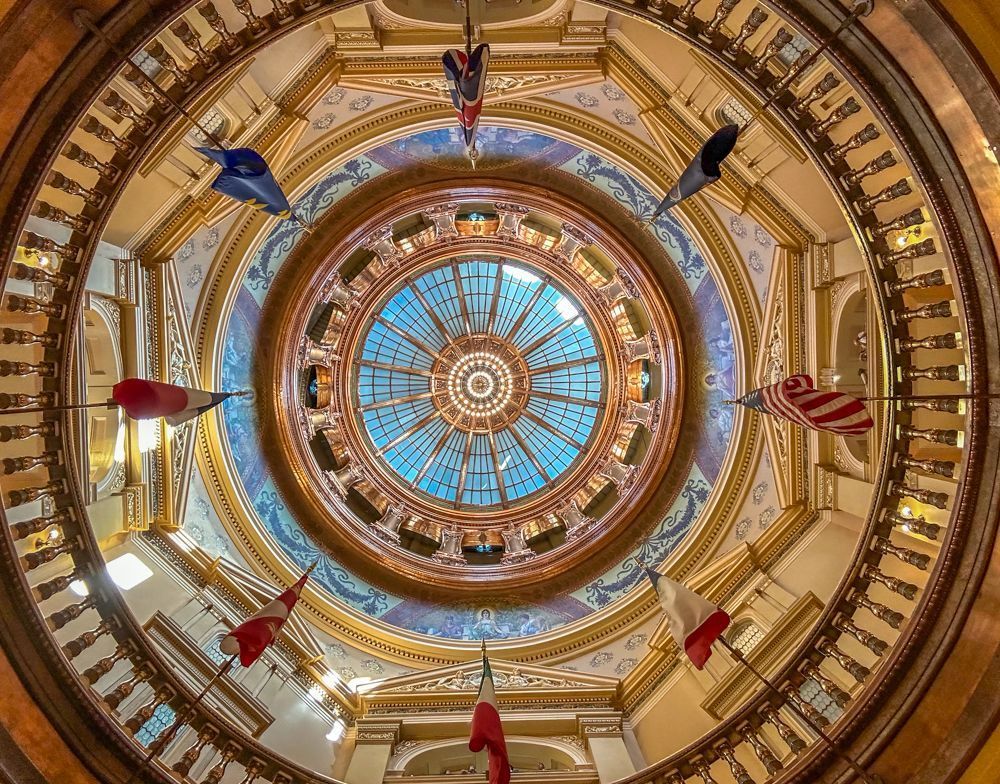
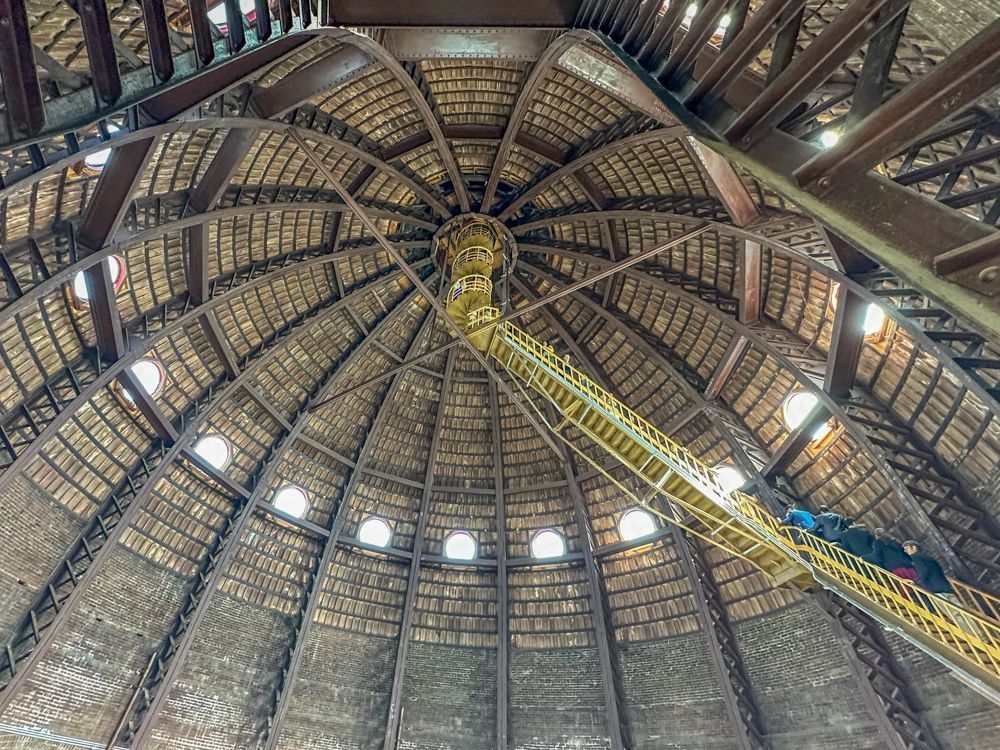
On the way back from the library, I stopped at the KS Capitol building. One of these days I’ll have to research why all Capitol buildings are topped with a dome. Like others, this Capitol building is ornate, although not nearly as ornate as some others. It does have several large murals depicting scenes from Kansas history. I took the dome tour, which, unlike others, offered the opportunity to climb via a suspended spiral staircase to the top of the dome. You can see the picture below. I elected to stop on the live just before this segment - it just did not seem necessary.
After a few hours rest, I drove out to the ranch home of my friends who I mentioned yesterday. They had invited me for a home-cooked dinner, always a treat on this trip. Dinner was delicious and we had a nice evening getting to know each other a bit better. We plan to meet one more time on Wednesday to photograph the Tall grass Prairie and Flint Hills area.
However, tomorrow I will visit the Brown vs. Board of Education museum.
This exhibit provided educational materials both in the form of videos and exhibit boards and also featured relevant art created by various Tribal members. I now understand that the Land Acknowledgment Statement, whether verbal or written, is considered a first step towards understanding and reconciliation. I have questioned throughout this journey what might be done to make some gesture, however small, to right the wrongs perpetrated on the original inhabitants of North America. As mentioned in the post from the St. Louis Gateway Arch museum, “Every square mile of land in the Americas once belonged to American Indians.”
To review a bit of history, Manifest Destiny , a phrase coined in 1845, is the idea that the United States was destined to expand its dominion across the entire North American continent. The philosophy drove 19th-century U.S. territorial expansion and was used to justify the forced removal of Native Americans from their lands. The Indian Removal Act of 1830 herded Tribal members ever westward. Initially about 10,000 Native Americans arrived to join Tribes already living in the Kansas Territory. Within a few decades, most were moved once again, many to Eastern Oklahoma, in order to make room for settlers.
In 1854, Senator Stephen Douglas (Illinois) introduced a bill which divided the land west of Missouri into two territories, Kansas and Nebraska. A main feature of the bill was that settlers of each new territories would retain the right to decide if slavery would be legal. This angered abolitionists, because under terms of the Missouri Compromise of 1829, Missouri was admitted as a slave state, Maine as a free state, and slavery would then be prohibited in the remaining Louisiana Purchase lands north of the 36°30′ parallel. The Kansas-Nebraska act was passed in 1854, precipitating a rush to Kansas of settlers of both persuasions. Each side hoped to determine the results of the first election by sheer numbers. This conflict turned violent and became known as "Bleeding Kansas." Ultimately, after much back and forth, Kansas was admitted to the Union as a free state. However, the ensuing chaos caused by the Kansas-Nebraska Act was a major factor in moving the U.S. closer to Civil War. Although the focus of organizing the new territories was on whether they would be free or slave territories, and eventually states, the collateral damage caused by the continued westward movement of settlers was to further displace Native peoples.
That same year, one month after the Shawnee Indians had ceded portions of their land to the U.S. Government, and six months after the Kansas-Nebraska Act became effective, a group from the East Coast traveled west to found towns that would anchor a free state. The city of Topeka was founded as part of that effort. The original townsite of Topeka, Wyandotte Float Number 20, was sold to the Topeka Town Association by Isaiah Walker, a citizen of the Wyandotte Nation. A "float" was an individual reservation instead a group reservation. I am not aware of this practice anywhere else - this is the first time I have encountered it.
Another story of which I was previously unaware - and I should have been because of my long-standing interest in dance - is that Maria Tallchief - progeny of a Native American Father (Osage Nation) and a Scottish-Irish mother - was the first American prima ballerina. She danced for Balanchine and debuted iconic roles such as Firebird and the Sugar Plum Fairy in the Nutcracker. She married Balanchine, although eventually divorced him and moved to Chicago to start a family with a second husband.
As a closing comment on this exhibit, I’ll quote from the exhibit that explains the Land Acknowledgment Statement.
A land acknowledgment statement is a respectful recognition of Indigenous peoples' deep historical ties to the land. It's an opportunity to honor their enduring presence, acknowledge past injustices, and promote awareness of Indigenous cultures. This practice fosters inclusivity and encourages dialogue about reconciliation, emphasizing the significance of the land in shaping our shared history.
On the way back from the library, I stopped at the KS Capitol building. One of these days I’ll have to research why all Capitol buildings are topped with a dome. Like others, this Capitol building is ornate, although not nearly as ornate as some others. It does have several large murals depicting scenes from Kansas history. I took the dome tour, which, unlike others, offered the opportunity to climb via a suspended spiral staircase to the top of the dome. You can see the picture below. I elected to stop on the live just before this segment - it just did not seem necessary.
After a few hours rest, I drove out to the ranch home of my friends who I mentioned yesterday. They had invited me for a home-cooked dinner, always a treat on this trip. Dinner was delicious and we had a nice evening getting to know each other a bit better. We plan to meet one more time on Wednesday to photograph the Tall grass Prairie and Flint Hills area.
However, tomorrow I will visit the Brown vs. Board of Education museum.
61 photo galleries
50 States
- Big Sur
- Salinas
- Laguna Beach
- San Diego
- California
- Grand Canyon
- Sedona
- Utah
- Syracuse
- Moab
- Denver
- Manitou Springs
- Calhan
- Mesa Verde
- Los Alamos
- Santa Fe
- Carlsbad
- New Mexico
- Eureka Springs
- Little Rock
- Birmingham
- Jackson
- Lottie
- Ten Thousand Islands
- Jerome
- Savannah
- White
- Asheville
- Sandstone Falls
- Baltimore
- Timonium
- Maryland
- Berlin
- Milton
- Smyrna
- Ocean City
- Detroit
- Upper Peninsula of Michigan
- Michigan
- Herod
- Ozark
- Two Harbors
- Carlton
- Madison County
- Oakley
- Valentine
- South Dakota
- United States
- Yellowstone National Park
- Lima
- Idaho
- Port Townsend
- Lincoln City
- Newport
- San Francisco