Portsmouth 2
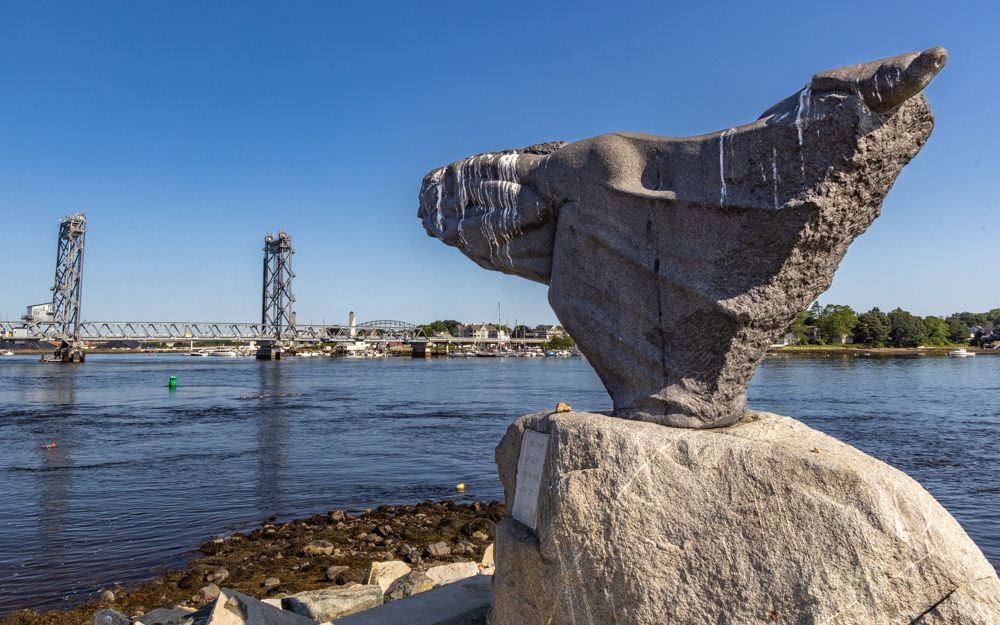
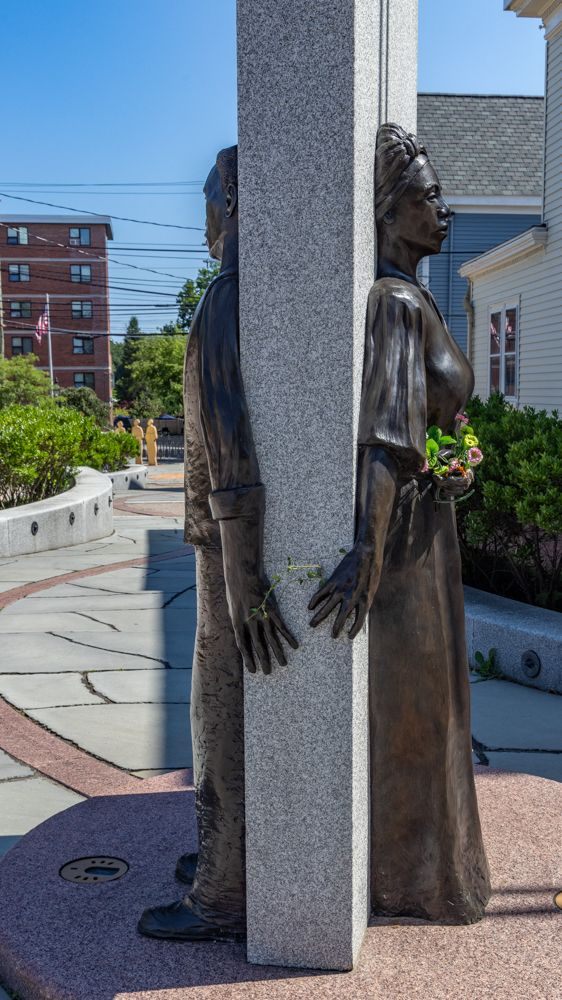
This morning I walked over to Four Trees Island . I have no idea from whence it gets its name as there are definitely more than four trees on it. It is really just a small spit of land in the harbor. Its main claim to fame is a statue of what looks like an old figurehead for the bow of a ship. It is entitled “For those who sailed here to find a new life.”
I then headed over to the Portsmouth Historical Society to join a walking tour. Docent-led tours were not something I chose in the past, but I have found them valuable on this trip, especially for the historical information. Jeff was our guide and was very knowledgeable and responsive. A few interesting stories are worth relating.
The first has to do with who fired the first shots of the Revolutionary War. The prevalent narrative is that the first shot was fired from the North Bridge in Concord, MA. New Hampshire tells another story . In December, 1774, rumors began to circulate that British troops were headed to reinforce Fort William and Mary, off the coast of the province of NH, and seize its powder and arms. On December 13, 1774, four months before his more famous ride in Massachusetts, Paul Revere rode to Portsmouth to sound the alarm. Once he arrived, Revere worked with local Patriots to plan a raid on the fort. On December 14, John Langdon made his way through Portsmouth with a drummer, collecting a crowd of hundreds to descend on the fort. When Langdon's men rushed the fort, British troops opened fire with three cannons and a volley of musket shot. Patriots stormed the walls, subduing the outnumbered British troops. Langdon's volunteers not only broke open the powder house and absconded with about 100 barrels of gunpowder but hauled down the fort's British flag. The captured supplies were later used by New Hampshire's forces against the British military, including in the Siege of Boston and at the Battle of Bunker Hill.
The second story has to do with the Treaty of Portsmouth that formally ended the 1904–1905 Russo-Japanese War. It was signed on September 5, 1905, at the Portsmouth Naval Shipyard. The location of this shipyard is now within the borders of Maine, but at the time it was considered part of Portsmouth. The unusual story behind the negotiations is that they depended on citizen diplomacy. Both sides were invited to Portsmouth and wined, dined and entertained by the citizenry. Apparently this sufficiently softened them up, allowing U.S. President Theodore Roosevelt to engineer the negotiations that resulted in the peace treaty. Roosevelt won the Nobel Peace Prize for his efforts.
The third story has to do with the Temple Israel , Jewish Synagogue in Portsmouth. Although Irish and Italians comprised the majority of second wave immigrants, people from Eastern Europe were already starting to flee persecution in the late 1800s and early 1900s. Some of these were Jews, many of whom were tailors. That skill was useful in a port city to sew sails, which is how a small Jewish community came to be established in Portsmouth. The synagogue was originally a Methodist church, that was purchased using the combined funds of about 40 Jewish families and retrofitted as a synagogue. The details to that story, which I heard later in the day at the Strawberry Banke Museum, is that the auction to sell the church was deliberately scheduled on a Saturday to prevent religious Jews from attending and bidding. Apparently an Irishman who was friendly with the Jewish community went in their stead and placed the winning bid. As the story goes, he won it at a far lower price than if the sellers knew it was being purchased by the Jews for a synagogue. Apparently both racism and anti-semitism were alive and well in Colonial New England.
After completing the walking tour, I went over to the Strawberry Banke Museum . This is a large campus comprising many original buildings that were saved from urban renewal. Like the Plymouth-Patuket museum, costumed docents are placed in and around the structures to talk about the culture and the inhabitants. I targeted a few different experiences as I did not have the fortitude to visit all of them.
I made a point to visit the building housing an exhibit about the original indigenous inhabitants of this land then known as Piscataqua. After thousands of years of stewardship of the land, the Wabanaki - ancestors of the Wabanaki, Abenaki and Pennacook peoples - were the first on this continent to encounter Europeans. Ultimately, these encounters devastated the Wabanaki and destroyed their traditional way of life. However, descendants of these ancient peoples have adapted, survived, and become contemporary citizens who are part of the fabric of their communities.
Another house I visited was the Shapiro house, where a Jewish family lived in Colonial times. It was from the docent in that house that I learned the details of the synagogue purchase.
I went into a few more houses and learned their stories. Then, although there was much more to experience at Strawberry Banke, I had reached my limit of both physical and mental endurance and called it a day.
Tomorrow I will see what is outside the vicinity of city of Portsmouth.
I then headed over to the Portsmouth Historical Society to join a walking tour. Docent-led tours were not something I chose in the past, but I have found them valuable on this trip, especially for the historical information. Jeff was our guide and was very knowledgeable and responsive. A few interesting stories are worth relating.
The first has to do with who fired the first shots of the Revolutionary War. The prevalent narrative is that the first shot was fired from the North Bridge in Concord, MA. New Hampshire tells another story . In December, 1774, rumors began to circulate that British troops were headed to reinforce Fort William and Mary, off the coast of the province of NH, and seize its powder and arms. On December 13, 1774, four months before his more famous ride in Massachusetts, Paul Revere rode to Portsmouth to sound the alarm. Once he arrived, Revere worked with local Patriots to plan a raid on the fort. On December 14, John Langdon made his way through Portsmouth with a drummer, collecting a crowd of hundreds to descend on the fort. When Langdon's men rushed the fort, British troops opened fire with three cannons and a volley of musket shot. Patriots stormed the walls, subduing the outnumbered British troops. Langdon's volunteers not only broke open the powder house and absconded with about 100 barrels of gunpowder but hauled down the fort's British flag. The captured supplies were later used by New Hampshire's forces against the British military, including in the Siege of Boston and at the Battle of Bunker Hill.
The second story has to do with the Treaty of Portsmouth that formally ended the 1904–1905 Russo-Japanese War. It was signed on September 5, 1905, at the Portsmouth Naval Shipyard. The location of this shipyard is now within the borders of Maine, but at the time it was considered part of Portsmouth. The unusual story behind the negotiations is that they depended on citizen diplomacy. Both sides were invited to Portsmouth and wined, dined and entertained by the citizenry. Apparently this sufficiently softened them up, allowing U.S. President Theodore Roosevelt to engineer the negotiations that resulted in the peace treaty. Roosevelt won the Nobel Peace Prize for his efforts.
The third story has to do with the Temple Israel , Jewish Synagogue in Portsmouth. Although Irish and Italians comprised the majority of second wave immigrants, people from Eastern Europe were already starting to flee persecution in the late 1800s and early 1900s. Some of these were Jews, many of whom were tailors. That skill was useful in a port city to sew sails, which is how a small Jewish community came to be established in Portsmouth. The synagogue was originally a Methodist church, that was purchased using the combined funds of about 40 Jewish families and retrofitted as a synagogue. The details to that story, which I heard later in the day at the Strawberry Banke Museum, is that the auction to sell the church was deliberately scheduled on a Saturday to prevent religious Jews from attending and bidding. Apparently an Irishman who was friendly with the Jewish community went in their stead and placed the winning bid. As the story goes, he won it at a far lower price than if the sellers knew it was being purchased by the Jews for a synagogue. Apparently both racism and anti-semitism were alive and well in Colonial New England.
After completing the walking tour, I went over to the Strawberry Banke Museum . This is a large campus comprising many original buildings that were saved from urban renewal. Like the Plymouth-Patuket museum, costumed docents are placed in and around the structures to talk about the culture and the inhabitants. I targeted a few different experiences as I did not have the fortitude to visit all of them.
I made a point to visit the building housing an exhibit about the original indigenous inhabitants of this land then known as Piscataqua. After thousands of years of stewardship of the land, the Wabanaki - ancestors of the Wabanaki, Abenaki and Pennacook peoples - were the first on this continent to encounter Europeans. Ultimately, these encounters devastated the Wabanaki and destroyed their traditional way of life. However, descendants of these ancient peoples have adapted, survived, and become contemporary citizens who are part of the fabric of their communities.
Another house I visited was the Shapiro house, where a Jewish family lived in Colonial times. It was from the docent in that house that I learned the details of the synagogue purchase.
I went into a few more houses and learned their stories. Then, although there was much more to experience at Strawberry Banke, I had reached my limit of both physical and mental endurance and called it a day.
Tomorrow I will see what is outside the vicinity of city of Portsmouth.

61 photo galleries
50 States
- Big Sur
- Salinas
- Laguna Beach
- San Diego
- California
- Grand Canyon
- Sedona
- Utah
- Syracuse
- Moab
- Denver
- Manitou Springs
- Calhan
- Mesa Verde
- Los Alamos
- Santa Fe
- Carlsbad
- New Mexico
- Eureka Springs
- Little Rock
- Birmingham
- Jackson
- Lottie
- Ten Thousand Islands
- Jerome
- Savannah
- White
- Asheville
- Sandstone Falls
- Baltimore
- Timonium
- Maryland
- Berlin
- Milton
- Smyrna
- Ocean City
- Detroit
- Upper Peninsula of Michigan
- Michigan
- Herod
- Ozark
- Two Harbors
- Carlton
- Madison County
- Oakley
- Valentine
- South Dakota
- United States
- Yellowstone National Park
- Lima
- Idaho
- Port Townsend
- Lincoln City
- Newport
- San Francisco