North Kingstown to Providence
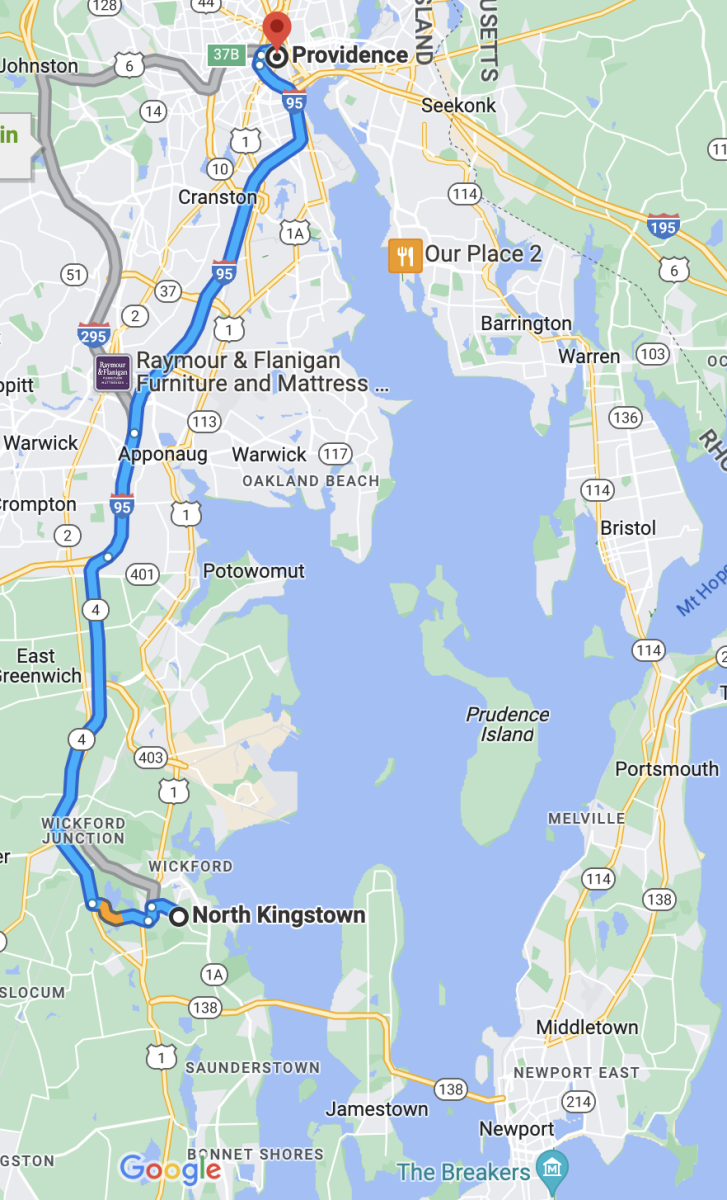
This morning I drove the short distance from North Kingstown to Providence.
I had only one planned activity this afternoon, a visit to the John Brown House Museum , conveniently located only a mile from my hotel. I was welcomed by Gianna, Kelvis and Luis. Also available to assist were Ellie and Michelle. I was glad to be in an air-conditioned building (obviously retrofitted) to escape the 90 degree heat and 80% humidity. Gianna, assisted by Kelvis gave an introduction to the house and its history, then set us loose to explore the exhibits on our own.
The John Brown House was the first mansion built in Providence, Rhode. It borders the campus of Brown University. The house is named after the original owner, one of the early benefactors of the university, merchant, statesman, and slave trader John Brown. Brown University is formally named for John Brown’s nephew, Nicholas Brown, Jr ., who would gift $5000 in 1804. Nicholas would also become an ardent abolitionist.
The museum uses the personal history of the Brown family as a jumping off point to explore early Rhode Island history and how it intersected with international trade. Because it had the finest natural harbor on the East Coast, Rhode Island was originally the largest center of maritime trade, include the slave trade.
The sordid history of sugar, both in connection with international trade and, continuing to modern day, to health, started with the arrival of European colonists. They had already developed a taste for refined sugar, dating back centuries and they were willing to go to great lengths to feed their addiction. By 1670 most of the sugar cane plantations were located in the Caribbean, where the Dutch, English and French had established colonies. Growing and producing sugar was a difficult and dangerous process; who better to work the fields and mills than slave labor.
Rhode Island’s entree into distilling molasses into rum made it one of three points of a terrible triangle. Ships would bring molasses from the Caribbean to Rhode Island, where it would be distilled into rum. The rum would then be shipped back to the Caribbean and also Africa, where it was traded for persons sold into slavery. Profits from the rum trade funded many of the Newport mansions that still sit on the cliffs today. Rum underpinned the entire economy of Rhode Island in the 1700s, prior to the Revolutionary war. The taxes imposed by the British on “foreign” sugar and molasses were a main contributor to the decision to break from England; Rhode Island, like all of the colonies, was not represented in the British Parliament. The British had incurred huge debts during the Seven Year’s War and hoped to tax the colonies to ease some of that debt. Taxation without representation was the main impetus for the Revolutionary war.
A significant venture financed by the Brown brothers, Nicholas, Joseph, John and Moses involved the slave ship Sally, which resulted in one of the most disastrous voyages in the long history of triangular trade. Perhaps because of the inexperience of Captain Esek Hopkins, perhaps because of a glut of slave ships arriving at the African coast after the cessation of hostilities between France and England, the Sally spent far too long obtaining the required human cargo. After 9 months, the Sally finally departed for the West Indies. Along the way, 109 African perished from sickness or suicide. Only 36 sickly and emaciated slaves were sold for a poor price on Antigua.
Captain Hopkins survived the voyage and overcame his disastrous captaincy to become a commander in chief of the Continental Navy, and eventually served in the Rhode Island state legislature. His name is memorialized on public sites around Providence. While Nicholas, Joseph and Moses withdrew from the slave trade for economic reasons, and Moses would eventually become an ardent abolitionist, John continued to traffic in slaves, even after it became illegal in Rhode Island, the first state to prohibit the practice.
In 1797, John Brown was charged with illegal slave trading; ironically by the Providence Abolition Society, an organization founded by his brother, Moses. Though he acknowledged his continued involvement in the trade, he was acquitted of the charge. This did not prevent his election to the U.S. House of Representatives, where he remained a vocal defender of the transatlantic slave trade.
Tomorrow promises more of the same and I fortunately have a couple more indoor activities planned
I had only one planned activity this afternoon, a visit to the John Brown House Museum , conveniently located only a mile from my hotel. I was welcomed by Gianna, Kelvis and Luis. Also available to assist were Ellie and Michelle. I was glad to be in an air-conditioned building (obviously retrofitted) to escape the 90 degree heat and 80% humidity. Gianna, assisted by Kelvis gave an introduction to the house and its history, then set us loose to explore the exhibits on our own.
The John Brown House was the first mansion built in Providence, Rhode. It borders the campus of Brown University. The house is named after the original owner, one of the early benefactors of the university, merchant, statesman, and slave trader John Brown. Brown University is formally named for John Brown’s nephew, Nicholas Brown, Jr ., who would gift $5000 in 1804. Nicholas would also become an ardent abolitionist.
The museum uses the personal history of the Brown family as a jumping off point to explore early Rhode Island history and how it intersected with international trade. Because it had the finest natural harbor on the East Coast, Rhode Island was originally the largest center of maritime trade, include the slave trade.
The sordid history of sugar, both in connection with international trade and, continuing to modern day, to health, started with the arrival of European colonists. They had already developed a taste for refined sugar, dating back centuries and they were willing to go to great lengths to feed their addiction. By 1670 most of the sugar cane plantations were located in the Caribbean, where the Dutch, English and French had established colonies. Growing and producing sugar was a difficult and dangerous process; who better to work the fields and mills than slave labor.
Rhode Island’s entree into distilling molasses into rum made it one of three points of a terrible triangle. Ships would bring molasses from the Caribbean to Rhode Island, where it would be distilled into rum. The rum would then be shipped back to the Caribbean and also Africa, where it was traded for persons sold into slavery. Profits from the rum trade funded many of the Newport mansions that still sit on the cliffs today. Rum underpinned the entire economy of Rhode Island in the 1700s, prior to the Revolutionary war. The taxes imposed by the British on “foreign” sugar and molasses were a main contributor to the decision to break from England; Rhode Island, like all of the colonies, was not represented in the British Parliament. The British had incurred huge debts during the Seven Year’s War and hoped to tax the colonies to ease some of that debt. Taxation without representation was the main impetus for the Revolutionary war.
A significant venture financed by the Brown brothers, Nicholas, Joseph, John and Moses involved the slave ship Sally, which resulted in one of the most disastrous voyages in the long history of triangular trade. Perhaps because of the inexperience of Captain Esek Hopkins, perhaps because of a glut of slave ships arriving at the African coast after the cessation of hostilities between France and England, the Sally spent far too long obtaining the required human cargo. After 9 months, the Sally finally departed for the West Indies. Along the way, 109 African perished from sickness or suicide. Only 36 sickly and emaciated slaves were sold for a poor price on Antigua.
Captain Hopkins survived the voyage and overcame his disastrous captaincy to become a commander in chief of the Continental Navy, and eventually served in the Rhode Island state legislature. His name is memorialized on public sites around Providence. While Nicholas, Joseph and Moses withdrew from the slave trade for economic reasons, and Moses would eventually become an ardent abolitionist, John continued to traffic in slaves, even after it became illegal in Rhode Island, the first state to prohibit the practice.
In 1797, John Brown was charged with illegal slave trading; ironically by the Providence Abolition Society, an organization founded by his brother, Moses. Though he acknowledged his continued involvement in the trade, he was acquitted of the charge. This did not prevent his election to the U.S. House of Representatives, where he remained a vocal defender of the transatlantic slave trade.
Tomorrow promises more of the same and I fortunately have a couple more indoor activities planned
61 photo galleries
50 States
- Big Sur
- Salinas
- Laguna Beach
- San Diego
- California
- Grand Canyon
- Sedona
- Utah
- Syracuse
- Moab
- Denver
- Manitou Springs
- Calhan
- Mesa Verde
- Los Alamos
- Santa Fe
- Carlsbad
- New Mexico
- Eureka Springs
- Little Rock
- Birmingham
- Jackson
- Lottie
- Ten Thousand Islands
- Jerome
- Savannah
- White
- Asheville
- Sandstone Falls
- Baltimore
- Timonium
- Maryland
- Berlin
- Milton
- Smyrna
- Ocean City
- Detroit
- Upper Peninsula of Michigan
- Michigan
- Herod
- Ozark
- Two Harbors
- Carlton
- Madison County
- Oakley
- Valentine
- South Dakota
- United States
- Yellowstone National Park
- Lima
- Idaho
- Port Townsend
- Lincoln City
- Newport
- San Francisco