Natick [Boston]
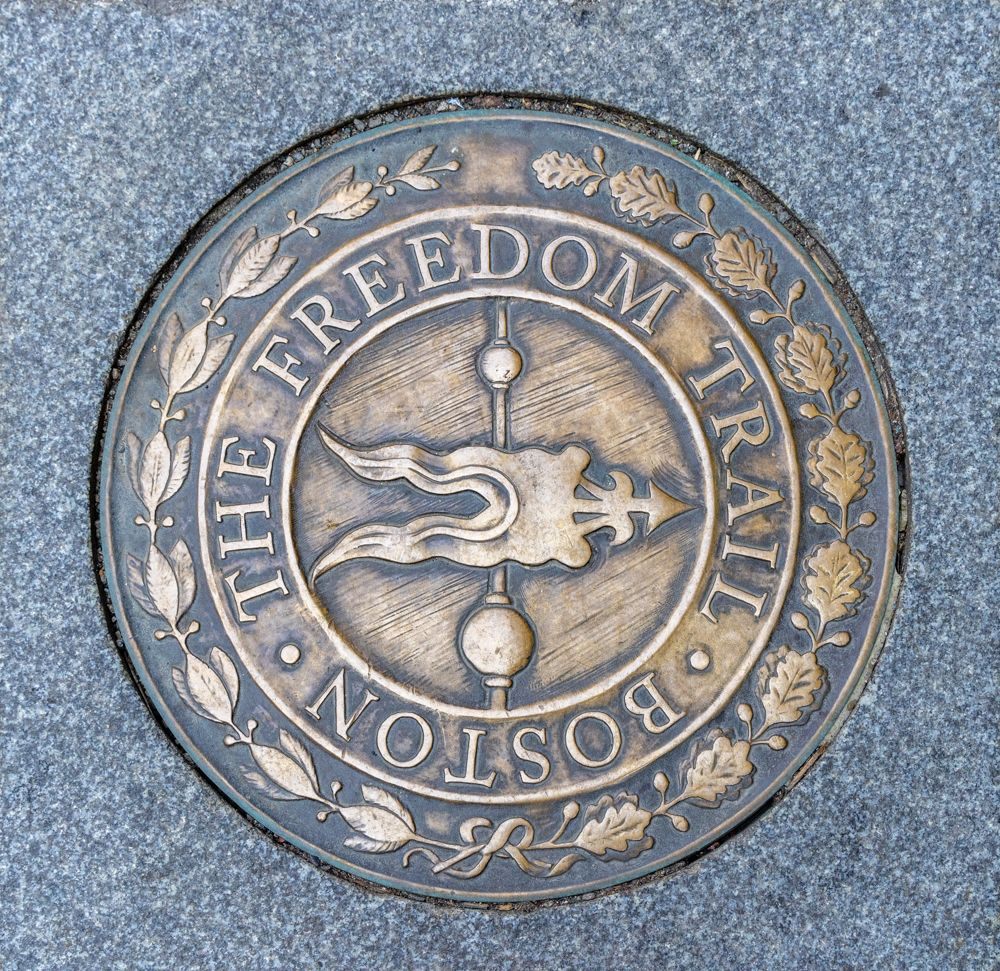
Today I drove into Boston proper to walk the Freedom Trail. When I lived in this area, I was only peripherally aware of all of the history that took place here; I certainly never took the time to explicitly explore it.
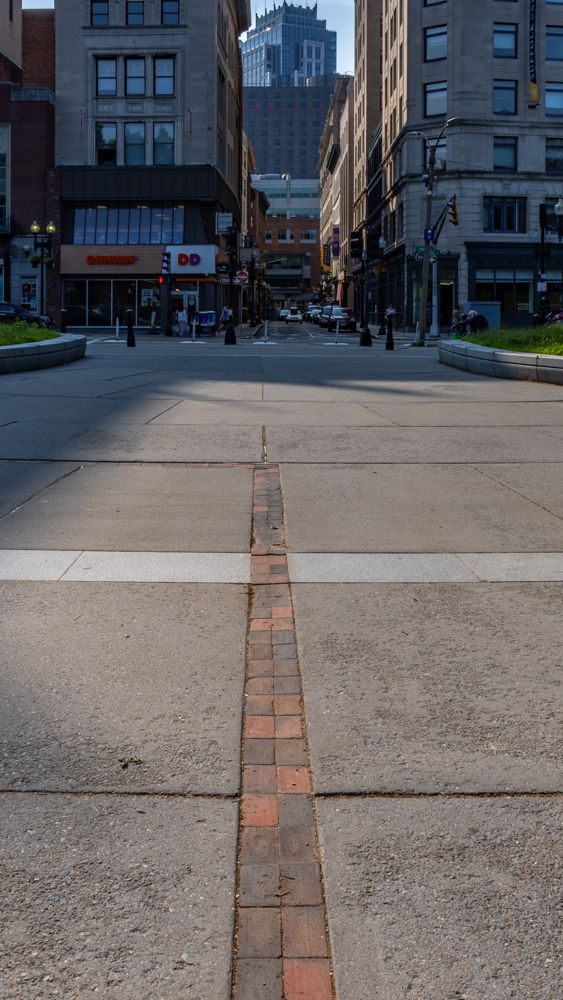
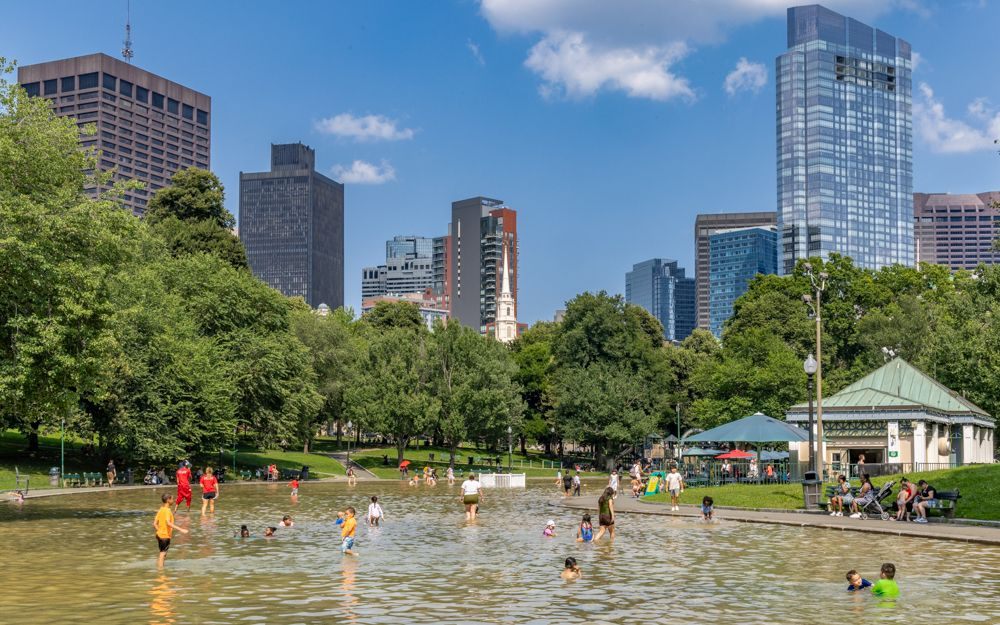
As suggested in the Freedom Trail guide, I parked my car in the Boston Common garage, then found the beginning of the trail, which starts just outside the visitor center on Boston Common. It is literally a red brick line set into the ground. I will say that just following this line could result in a bit of confusion - I was interpolating between a few different resources as I had researched the main sites ahead of time.
The sites on the walking tour are set out in geographical convenience, not chronological order. The excellent guidebook I purchases provides a chronology, so I think it makes sense to reorganize my day to follow the historical events in proper order. For the purpose of streamlining this post, I will choose the events that seem most relevant. I’m not writing a history book here. Even so, this will be quite a long post. As such, I will put the bulk of the text AFTER the images, so those who prefer to just look at the pictures don’t need to wade through it.
As an aside, this is the second time this trip that I have randomly run into someone I met earlier in the trip in an another city. In both cases, I knew the person would be in town, but in a city the size of current day Boston, it is remarkable coincidence.
As suggested in the Freedom Trail guide, I parked my car in the Boston Common garage, then found the beginning of the trail, which starts just outside the visitor center on Boston Common. It is literally a red brick line set into the ground. I will say that just following this line could result in a bit of confusion - I was interpolating between a few different resources as I had researched the main sites ahead of time.
The sites on the walking tour are set out in geographical convenience, not chronological order. The excellent guidebook I purchases provides a chronology, so I think it makes sense to reorganize my day to follow the historical events in proper order. For the purpose of streamlining this post, I will choose the events that seem most relevant. I’m not writing a history book here. Even so, this will be quite a long post. As such, I will put the bulk of the text AFTER the images, so those who prefer to just look at the pictures don’t need to wade through it.
As an aside, this is the second time this trip that I have randomly run into someone I met earlier in the trip in an another city. In both cases, I knew the person would be in town, but in a city the size of current day Boston, it is remarkable coincidence.


The American Revolution
1630 - The Puritans arrive in Massachusetts and settle Boston.
Of course the Wampanoag people lived in the area for many thousands of years before the first white settler. That was William Blackstone who lived on the piece of land that would eventually become Boston Common. When the Puritans, who first settled in Charlestown, found their water supply inadequate, Blackstone invited them across the river. They named their new settlement Boston, after a town in England from which many had come. Blackstone sold the land to the Puritans, who used it as a cow pasture and moved to Rhode Island. Some blame the original “cow paths” for the circuitous street patterns in downtown Boston.
1636 - Soon after the colony was founded, the first public school, Boston Latin School was started.
1713 - The Old State House was erected.
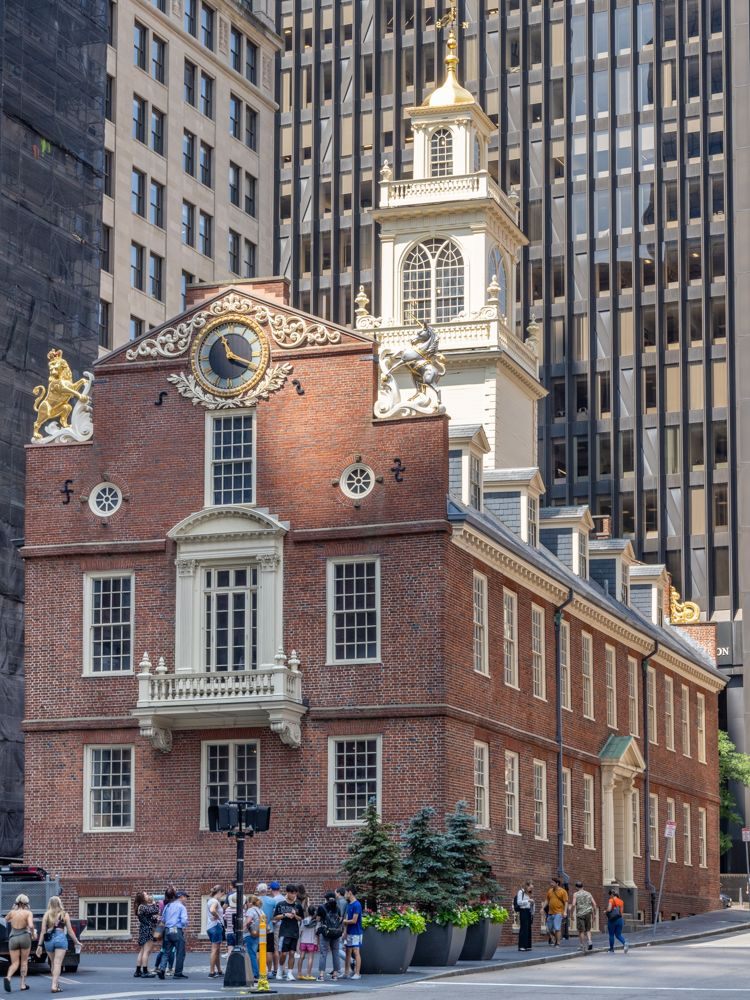
It is still the oldest public building still standing in the Eastern U.S., and was once the most imposing structure in all of Boston. It was home both to the royally-appointed officials such as the governor, and also to the freely elected Massachusetts Assembly. Inevitably, it became the scene of many a confrontation between the colonists and their royalist rulers. Here was heard James Otis’ “Writs of Assistance ” which was presented in 1761, a full 15 years before independence was declared. From its balcony could be seen the 1770 Boston Massacre, in which five Bostonians were killed by a squad of British Officers. This was the first bloodshed of what would become the American Revolution. It inspired Paul Revere’s factually inaccurate, but effective, “Bloody Massacre” engraving. Ironically, John Adams and Josiah Quincy defended the British massacre soldiers in court and won an acquittal for all but two of them.
1729 - The Old South Meeting House was reconstructed.
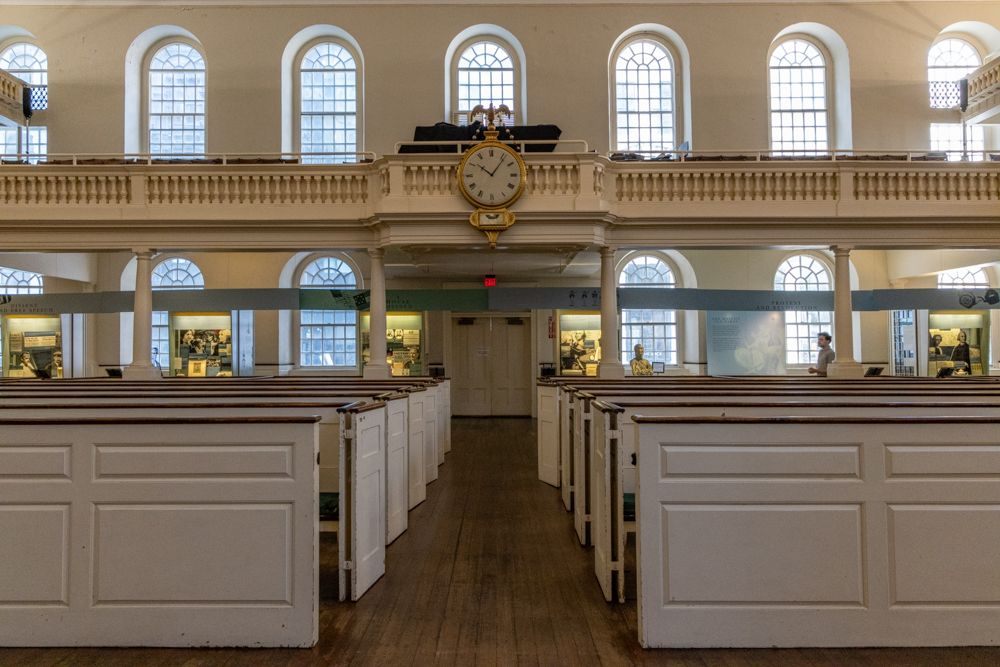
Construction was begun on a brick building to replace a cedar wood church erected 60 years earlier. Because it was the largest hall in town, it became the default location for town meetings when Faneuil Hall could not contain the crowds, and became known as the Old South Meeting House. Many of the crucial events that led up to the Revolution took place here. This included meetings that occurred after the Boston Massacre, and meetings in response to the Tea Act, engendering the Boston Tea Party. It was the first building in Boston to be preserved simply for its historical significance.
1742 - Faneuil Hall was built
The city’s political focal point for over two and a half centuries, this hall was a gift from Peter Faneuil, one of the most successful merchants in town. In this building, Americans first protested the Sugar Act and set down the doctrine of “no taxation without representation.” They rallied against, the Stamp Act, the Townshend Acts and the landing of British troops. Here they held the funeral for the victims of the Boston Massacre. And on November 5, 1773, led by John Hancock, they held the first of the Tea Meetings. After the American Revolution, the Hall was the chief rallying place for the abolitionist movement and the women’s suffrage movement. It continues to be a monument to liberty and free speech.
1749 - The King’s Chapel was constructed.
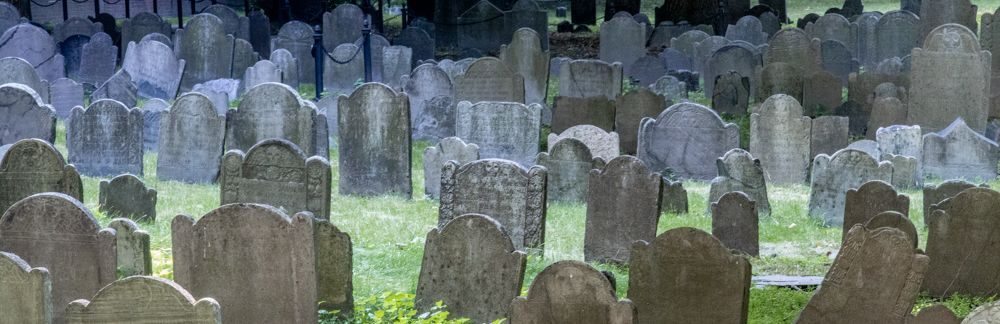
This church, representing all the the Puritans came to the New World to escape, was designed by America’s first architect, Peter Harrison of Newport RI. Recollect that he also designed the Touro Synagogue in Newport. In the burying ground next door lie Mary Chilton, the first Pilgrim to touch land in America and Elizabeth Pain, whose headstone inspired Nathanial Hawthorne’s “The Scarlett Letter.” William Dawes, who successfully rode to Concord to warn of the British attack on April 19, 1775 was said to have been buried here, but in 2006 documents were discovered that place his remains in an unmarked grave at the Forest Hill Cemetery in Jamaica Plain.
1756-1763 - The Seven Years’ war occurs.
Britain is vanquished by the French and is left with a drained treasury. This leads to various attempts to tax the colonies to refill the coffers, which leads directly to the American Revolution.
1763 - The Sugar Act is passed.
This act levied high taxes on sugar and molasses not originating from the British West Indies Company plantations in the Caribbean. Recollect that this was part of the “triangle” localized in Newport, RI, in which, Sugar/molasses, rum and the slave trade made for a vicious international trade set-up.
1765 -The Stamp Act is passed
This incites riots and is repealed a year later.
1767 - The Townshend Acts are passed
These acts replaced and expanded the Stamp act to all sorts of goods, not just paper. A boycott against imported (taxed) goods begins.
1770 - The Boston Massacre occurs.
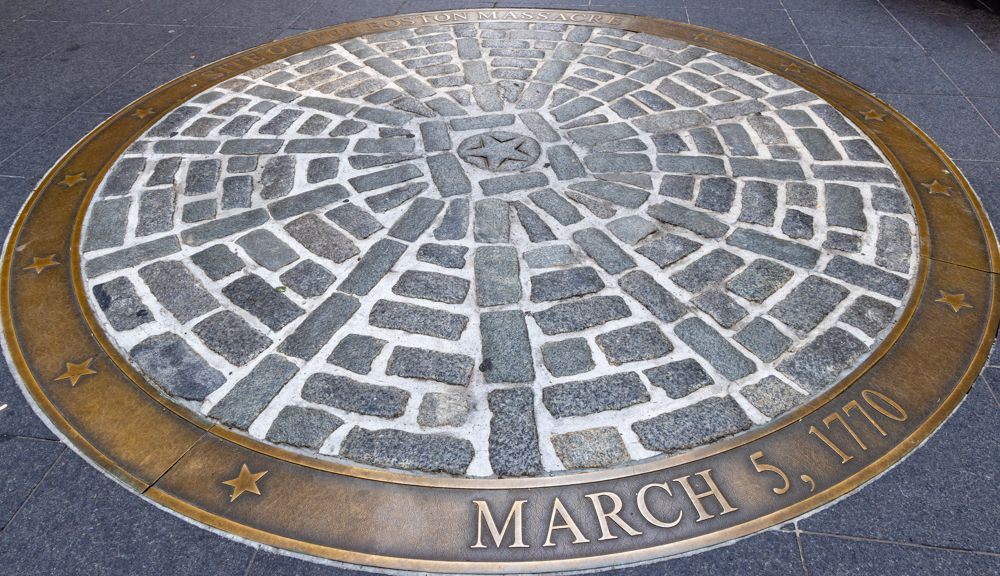
Nine British soldiers shot several of a crowd of three or four hundred who were harassing them verbally and throwing various projectiles in response to the Townshend Acts. Produced just three weeks after the Boston Massacre, Paul Revere’s historic engraving "The Bloody Massacre in King-Street " was probably the most effective (although inaccurate) piece of war propaganda in American history.
1773 - The Tea Act was passed.
This led to the infamous Boston Tea Party, which in turn was the tipping point leading to the American Revolution. Parliament had first levied a tax on tea as part of the Townshend Acts of 1767. However non-importation boycotts prevented the taxed tea from being sold. As well, smuggled tea from Holland undercut the price of legal, taxed tea. The Tea Act was essentially a bailout of the East India Company, accomplished by subsidizing the price, enabling it to undercut smuggled tea. The Tea Act also gave a monopoly to “consignees” who turned out to be friends and relatives of the royally appointed Governor Hutchinson. Bostonian merchants were properly concerned that this was a slippery slope, and would soon extend to other goods and services. They also saw it as a ruse to get them to pay the tax on tea that they had long opposed. On December 16, The Tea Party began at the Old South Meeting house. A crowd of about 1000 people, some participants, some observers, some wearing poor imitations of Native dress and whooping, boarded the three docked tea ships, and dumped the entire shipment into the sea.
1774 - In response to the Boston Tea Party, the “Intolerable Acts ” are passed.
The town’s port was closed and all local elected government was abolished. The right to assemble was denied, further galvanizing the colonists to revolt.
1775 - The Old North Church is the site of “two if by sea”
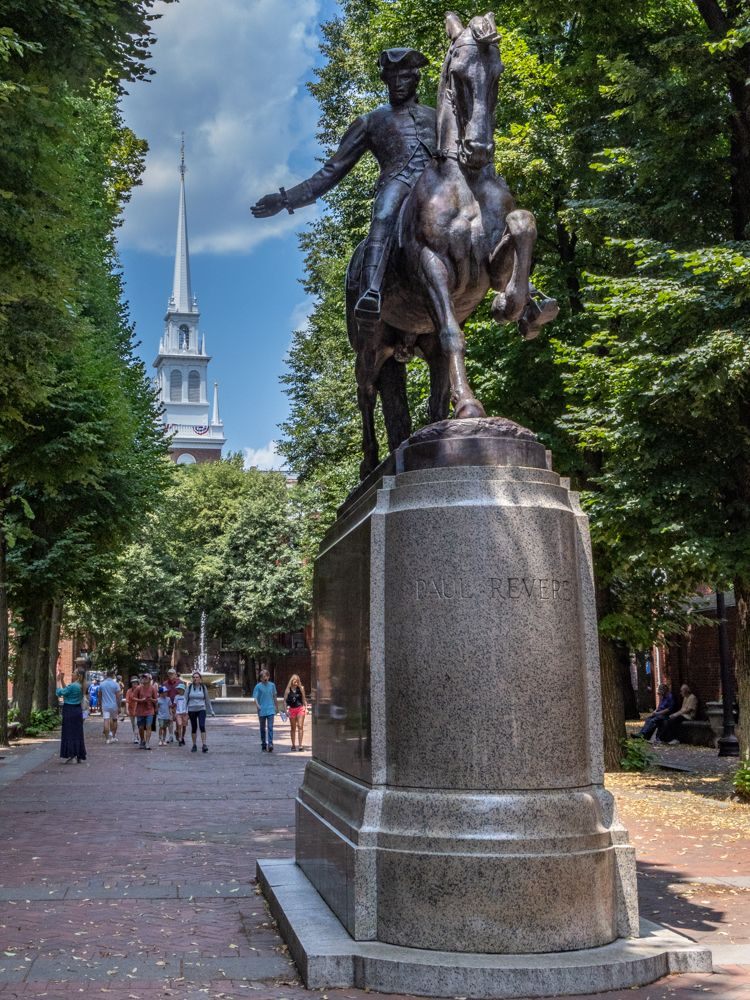
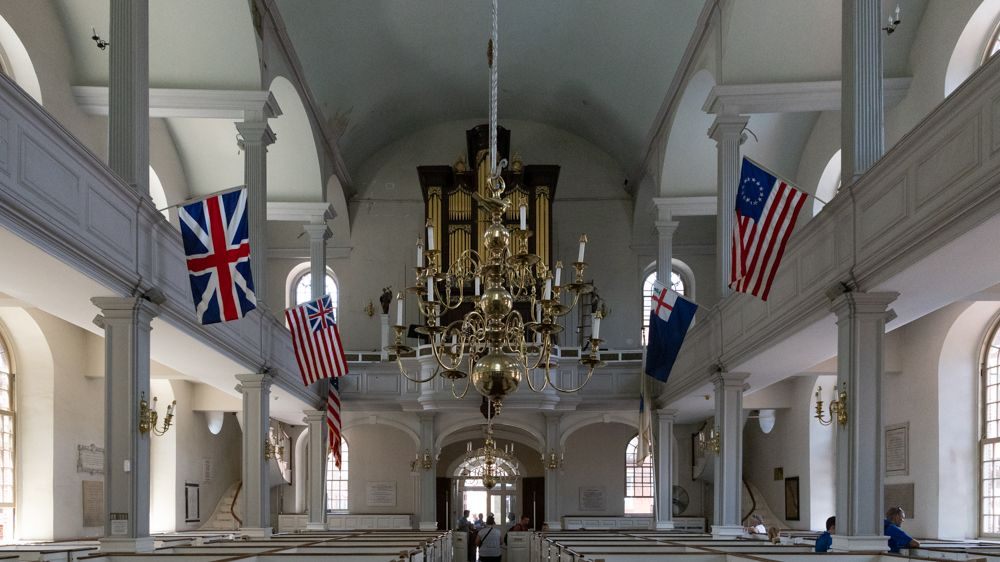
Here, briefly, two lanterns were show to indicate that Paul Revere had seen the British cross the Charles river to take the Northern route to Concord, rather than the Southern land route. After the infamous ride of Revere (and, significantly, William Dawes) the battles of Lexington and Concord officially kicked off the American Revolution. The first round went to the Colonists and the siege of Boston begins.
1775 - on June 17, the Battle of Bunker Hill was fought.
To conserve gunpowder, the Americans had order not to fire “’til you see the whites of their eyes.” Eventually, the Patriots did indeed run out of gunpowder and technically the British won the day. But the Empire was so depleted that the battle was a turning point towards British surrender. George Washington is made commander in chief of the Continental Army.
1776 - The Declaration of Independence is adopted in Philadelphia, and published on July 4.
1781 - The final surrender of the British Army occurs after the Battle of Yorktown in Virginia.
1781 - The Old Corner Bookstore.
What became known as the “Old Corner Book Store” was originally an apothecary shop. However its contribution to history occurred in the mid 1800s, when it became the office to Ticknor and Fields, the nation’s leading book publisher. Many of the greatest authors in American history regularly gathered here, including Longfellow, Hawthorne, Emerson, and Harriet Beecher Stowe. Among the publications were: Walden, The Scarlet Letter, Hiawatha, Julia Ward Howe’s “Battle Hymn of the Republic,” and the Atlantic Monthly.
1783 - The Treaty of Paris is signed between the United States and Great Britain.
1795 - Construction is begun on the “new State House”
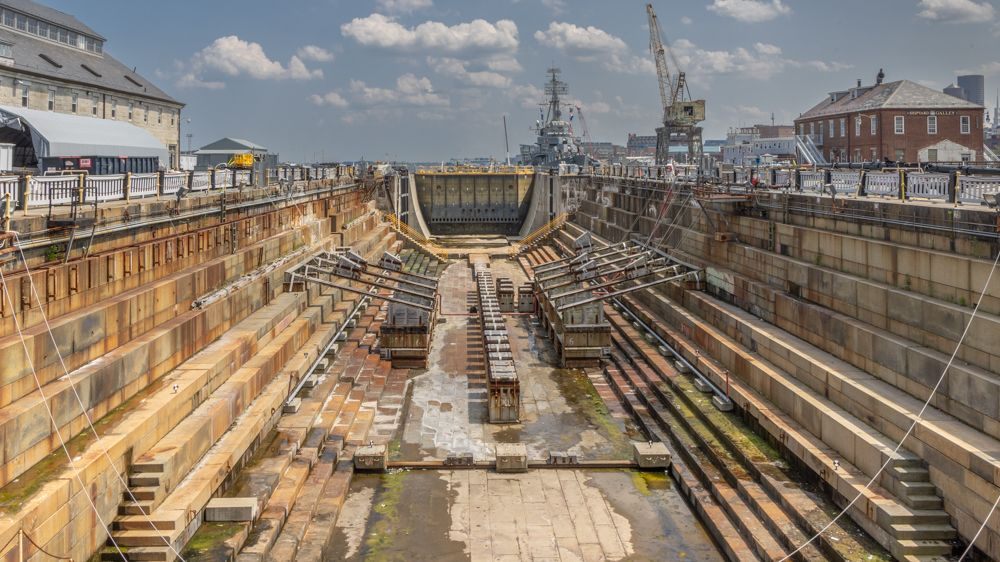
1797 - The U.S.S Constitution was launched.
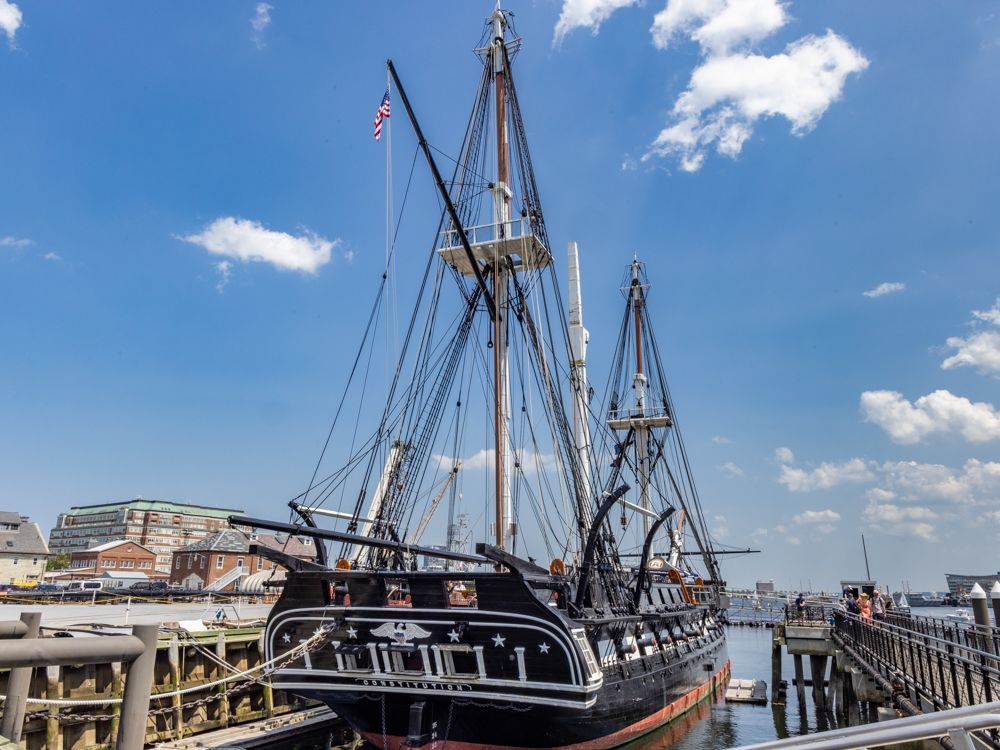
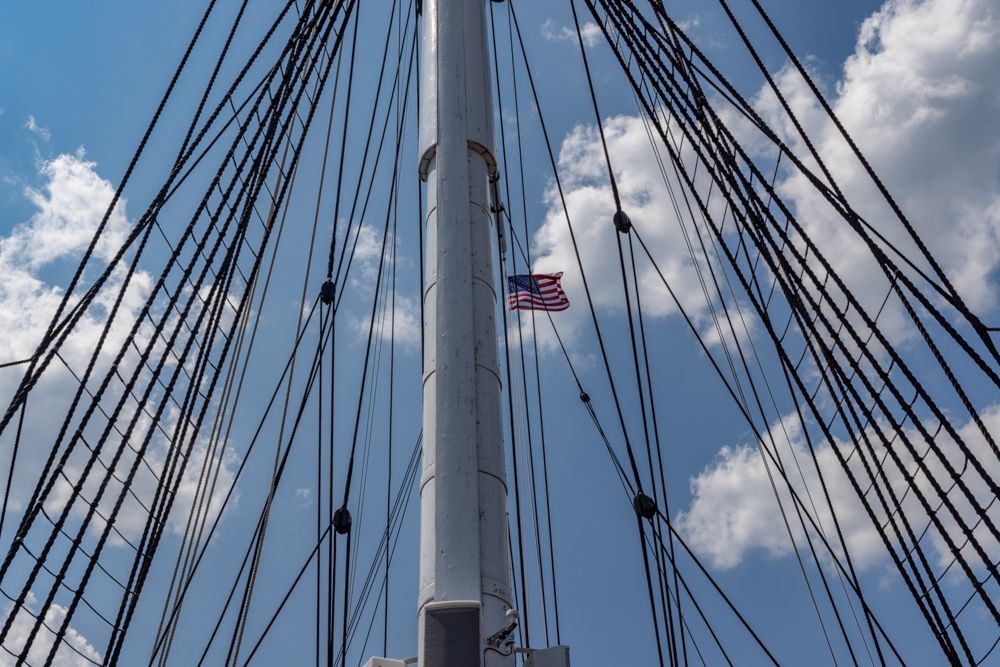
One of the U.S. Navy’s first vessels, she has protected U.S. citizens from British and French navies and Algerian pirates. She became known as “Old Ironsides” as a tribute to her seeming indestructibility. Her greatest exploits came during the war of 1812, another war with the British. After a number of renovations, one at the behest of children who collected pennies, the U.S.S Constitution remains an active commissioned ship in the U.S Navy.
1809 - The Park Street Church built.
The church was commandeered for different uses over the years. At one point it contained the town granary, a space that was later used to make sails for the USS Constitution. It was nicknamed “Brimstone Corner” for the gunpowder stored there during the war of 1812. Several notables are buried in the Granary burying ground adjacent to the church, including Ben Franklin, Peter Faneuil, John Hancock, Samual Adams and Paul Revere. It also contains monuments to James Otis and the victims of the Boston Massacre.
1630 - The Puritans arrive in Massachusetts and settle Boston.
Of course the Wampanoag people lived in the area for many thousands of years before the first white settler. That was William Blackstone who lived on the piece of land that would eventually become Boston Common. When the Puritans, who first settled in Charlestown, found their water supply inadequate, Blackstone invited them across the river. They named their new settlement Boston, after a town in England from which many had come. Blackstone sold the land to the Puritans, who used it as a cow pasture and moved to Rhode Island. Some blame the original “cow paths” for the circuitous street patterns in downtown Boston.
1636 - Soon after the colony was founded, the first public school, Boston Latin School was started.
1713 - The Old State House was erected.
It is still the oldest public building still standing in the Eastern U.S., and was once the most imposing structure in all of Boston. It was home both to the royally-appointed officials such as the governor, and also to the freely elected Massachusetts Assembly. Inevitably, it became the scene of many a confrontation between the colonists and their royalist rulers. Here was heard James Otis’ “Writs of Assistance ” which was presented in 1761, a full 15 years before independence was declared. From its balcony could be seen the 1770 Boston Massacre, in which five Bostonians were killed by a squad of British Officers. This was the first bloodshed of what would become the American Revolution. It inspired Paul Revere’s factually inaccurate, but effective, “Bloody Massacre” engraving. Ironically, John Adams and Josiah Quincy defended the British massacre soldiers in court and won an acquittal for all but two of them.
1729 - The Old South Meeting House was reconstructed.
Construction was begun on a brick building to replace a cedar wood church erected 60 years earlier. Because it was the largest hall in town, it became the default location for town meetings when Faneuil Hall could not contain the crowds, and became known as the Old South Meeting House. Many of the crucial events that led up to the Revolution took place here. This included meetings that occurred after the Boston Massacre, and meetings in response to the Tea Act, engendering the Boston Tea Party. It was the first building in Boston to be preserved simply for its historical significance.
1742 - Faneuil Hall was built
The city’s political focal point for over two and a half centuries, this hall was a gift from Peter Faneuil, one of the most successful merchants in town. In this building, Americans first protested the Sugar Act and set down the doctrine of “no taxation without representation.” They rallied against, the Stamp Act, the Townshend Acts and the landing of British troops. Here they held the funeral for the victims of the Boston Massacre. And on November 5, 1773, led by John Hancock, they held the first of the Tea Meetings. After the American Revolution, the Hall was the chief rallying place for the abolitionist movement and the women’s suffrage movement. It continues to be a monument to liberty and free speech.
1749 - The King’s Chapel was constructed.
This church, representing all the the Puritans came to the New World to escape, was designed by America’s first architect, Peter Harrison of Newport RI. Recollect that he also designed the Touro Synagogue in Newport. In the burying ground next door lie Mary Chilton, the first Pilgrim to touch land in America and Elizabeth Pain, whose headstone inspired Nathanial Hawthorne’s “The Scarlett Letter.” William Dawes, who successfully rode to Concord to warn of the British attack on April 19, 1775 was said to have been buried here, but in 2006 documents were discovered that place his remains in an unmarked grave at the Forest Hill Cemetery in Jamaica Plain.
1756-1763 - The Seven Years’ war occurs.
Britain is vanquished by the French and is left with a drained treasury. This leads to various attempts to tax the colonies to refill the coffers, which leads directly to the American Revolution.
1763 - The Sugar Act is passed.
This act levied high taxes on sugar and molasses not originating from the British West Indies Company plantations in the Caribbean. Recollect that this was part of the “triangle” localized in Newport, RI, in which, Sugar/molasses, rum and the slave trade made for a vicious international trade set-up.
1765 -The Stamp Act is passed
This incites riots and is repealed a year later.
1767 - The Townshend Acts are passed
These acts replaced and expanded the Stamp act to all sorts of goods, not just paper. A boycott against imported (taxed) goods begins.
1770 - The Boston Massacre occurs.
Nine British soldiers shot several of a crowd of three or four hundred who were harassing them verbally and throwing various projectiles in response to the Townshend Acts. Produced just three weeks after the Boston Massacre, Paul Revere’s historic engraving "The Bloody Massacre in King-Street " was probably the most effective (although inaccurate) piece of war propaganda in American history.
1773 - The Tea Act was passed.
This led to the infamous Boston Tea Party, which in turn was the tipping point leading to the American Revolution. Parliament had first levied a tax on tea as part of the Townshend Acts of 1767. However non-importation boycotts prevented the taxed tea from being sold. As well, smuggled tea from Holland undercut the price of legal, taxed tea. The Tea Act was essentially a bailout of the East India Company, accomplished by subsidizing the price, enabling it to undercut smuggled tea. The Tea Act also gave a monopoly to “consignees” who turned out to be friends and relatives of the royally appointed Governor Hutchinson. Bostonian merchants were properly concerned that this was a slippery slope, and would soon extend to other goods and services. They also saw it as a ruse to get them to pay the tax on tea that they had long opposed. On December 16, The Tea Party began at the Old South Meeting house. A crowd of about 1000 people, some participants, some observers, some wearing poor imitations of Native dress and whooping, boarded the three docked tea ships, and dumped the entire shipment into the sea.
1774 - In response to the Boston Tea Party, the “Intolerable Acts ” are passed.
The town’s port was closed and all local elected government was abolished. The right to assemble was denied, further galvanizing the colonists to revolt.
1775 - The Old North Church is the site of “two if by sea”
Here, briefly, two lanterns were show to indicate that Paul Revere had seen the British cross the Charles river to take the Northern route to Concord, rather than the Southern land route. After the infamous ride of Revere (and, significantly, William Dawes) the battles of Lexington and Concord officially kicked off the American Revolution. The first round went to the Colonists and the siege of Boston begins.
1775 - on June 17, the Battle of Bunker Hill was fought.
To conserve gunpowder, the Americans had order not to fire “’til you see the whites of their eyes.” Eventually, the Patriots did indeed run out of gunpowder and technically the British won the day. But the Empire was so depleted that the battle was a turning point towards British surrender. George Washington is made commander in chief of the Continental Army.
1776 - The Declaration of Independence is adopted in Philadelphia, and published on July 4.
1781 - The final surrender of the British Army occurs after the Battle of Yorktown in Virginia.
1781 - The Old Corner Bookstore.
What became known as the “Old Corner Book Store” was originally an apothecary shop. However its contribution to history occurred in the mid 1800s, when it became the office to Ticknor and Fields, the nation’s leading book publisher. Many of the greatest authors in American history regularly gathered here, including Longfellow, Hawthorne, Emerson, and Harriet Beecher Stowe. Among the publications were: Walden, The Scarlet Letter, Hiawatha, Julia Ward Howe’s “Battle Hymn of the Republic,” and the Atlantic Monthly.
1783 - The Treaty of Paris is signed between the United States and Great Britain.
1795 - Construction is begun on the “new State House”
1797 - The U.S.S Constitution was launched.
One of the U.S. Navy’s first vessels, she has protected U.S. citizens from British and French navies and Algerian pirates. She became known as “Old Ironsides” as a tribute to her seeming indestructibility. Her greatest exploits came during the war of 1812, another war with the British. After a number of renovations, one at the behest of children who collected pennies, the U.S.S Constitution remains an active commissioned ship in the U.S Navy.
1809 - The Park Street Church built.
The church was commandeered for different uses over the years. At one point it contained the town granary, a space that was later used to make sails for the USS Constitution. It was nicknamed “Brimstone Corner” for the gunpowder stored there during the war of 1812. Several notables are buried in the Granary burying ground adjacent to the church, including Ben Franklin, Peter Faneuil, John Hancock, Samual Adams and Paul Revere. It also contains monuments to James Otis and the victims of the Boston Massacre.
61 photo galleries
50 States
- Big Sur
- Salinas
- Laguna Beach
- San Diego
- California
- Grand Canyon
- Sedona
- Utah
- Syracuse
- Moab
- Denver
- Manitou Springs
- Calhan
- Mesa Verde
- Los Alamos
- Santa Fe
- Carlsbad
- New Mexico
- Eureka Springs
- Little Rock
- Birmingham
- Jackson
- Lottie
- Ten Thousand Islands
- Jerome
- Savannah
- White
- Asheville
- Sandstone Falls
- Baltimore
- Timonium
- Maryland
- Berlin
- Milton
- Smyrna
- Ocean City
- Detroit
- Upper Peninsula of Michigan
- Michigan
- Herod
- Ozark
- Two Harbors
- Carlton
- Madison County
- Oakley
- Valentine
- South Dakota
- United States
- Yellowstone National Park
- Lima
- Idaho
- Port Townsend
- Lincoln City
- Newport
- San Francisco