Mississippi to Louisiana
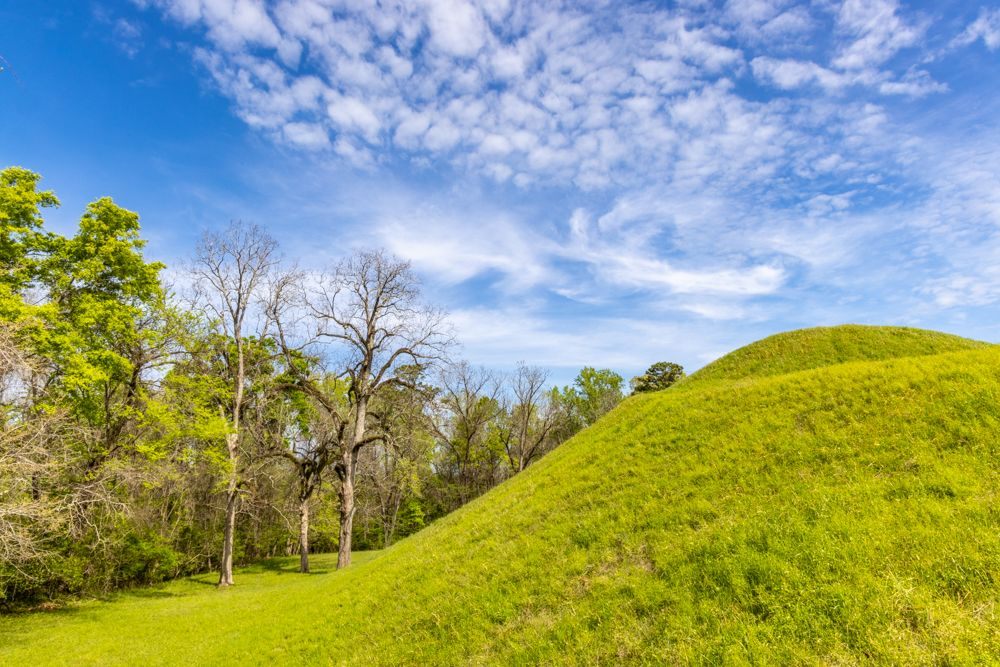
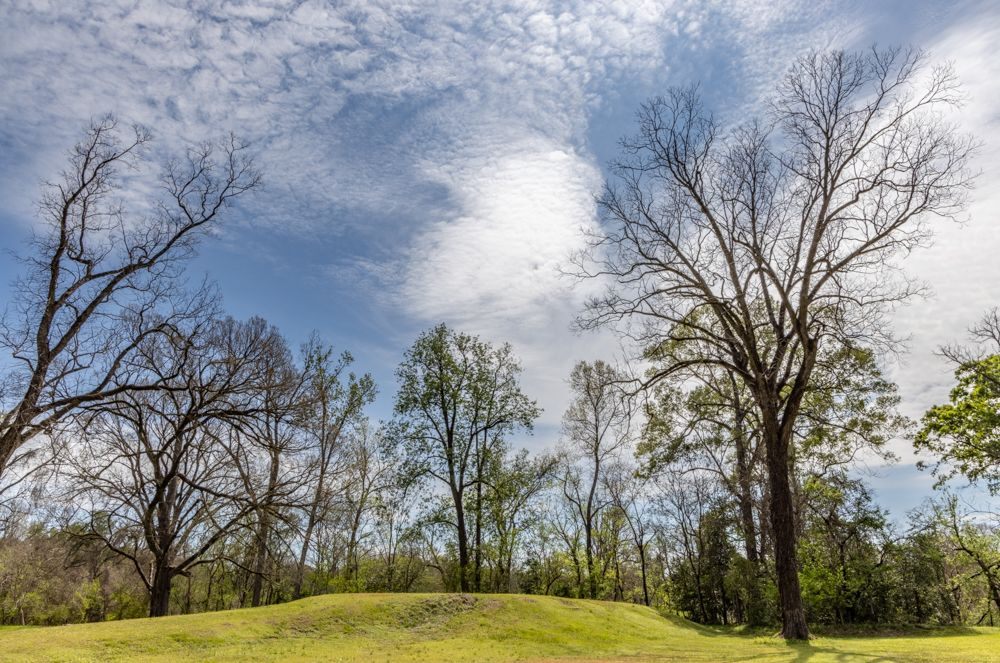
Before crossing over into Louisiana, I wanted to stop at Natchez, an historically important town along the Mississippi River. It was home to the Natchez Indian tribe and subsequently the first city in Mississipi. It has been continuously inhabited by various indigenous cultures since the 8th century AD, The Natchez, descendants of the Plaquemine culture, left many mounds that were used for various purposes, both ceremonial and practical. I stopped at both the Emerald Mound , one of several mounds and other historical sites along the Natchez Trace, and the Grand Village of the Natchez , comprising several mounds in Natchez proper. Visiting in the present day, however, one just sees grass covered mounds. Artifacts from the mounds have been excavated and preserved.
Another stop in Natchez was the Natchez Museum of African American Culture and History . This museum is small, but well curated. The exhibits laid out in great detail the history of Natchez , and rooms were also devoted to African art and culture and successful and important people who came from Natchez. We viewed a short video about the history of Natchez, and then Bobby, who was working at the museum, came in and expanded on various subjects and took questions. Bobby was clearly both passionate and knowledgeable about the subject. He was particularly interested in highlighting the African American experience in a region that had historically been known for its colonial culture and Antebellum homes. He wanted us to know that Natchez was and continues to be one of the most progressive and integrated cities in Mississippi.
As mentioned in yesterday’s blog post, Natchez was the site of various colonial rules, the French, British and Spanish, and eventually home to the infamous Forks of the Road Slave Market . Many of the slaves sold at this market had been purchased less expensively from Islands in the Atlantic rather the continent of Africa .
The region also pioneered, and had one of the most prolific, cotton industries in the South. Natchez was the origin of the Natchez Trace overland route, a Native American trail that followed a path established by migrating buffalo, which ran from Natchez to Nashville through what are now Mississippi, Alabama, and Tennessee. It was a major thoroughfare for commerce until steamboats enabled transport upstream on the Mississippi River. You can now drive the entire trace.
Natchez was also unusual in that it boasted a substantial number of free persons of color during the era of slavery. Many of these individuals were the offspring of white plantation owners and either enslaved or emancipated black women. The children benefited from paternal inheritances or business opportunities afforded them by their paternal families.
There is much more to the very nuanced history of Natchez and the surrounding region which, if you are interested, you can read in the links. I also learned of a book by Antoine-Simon Le Page du Pratz , a French ethnographer, historian, and naturalist, who lived in Louisiana in the mid-1700s. He learned the Natchez language and befriended native leaders. In his writings he apparently gives lengthy descriptions of Natchez society and its culture. His book is considered a main source of reliable information about the Natchez during that period.
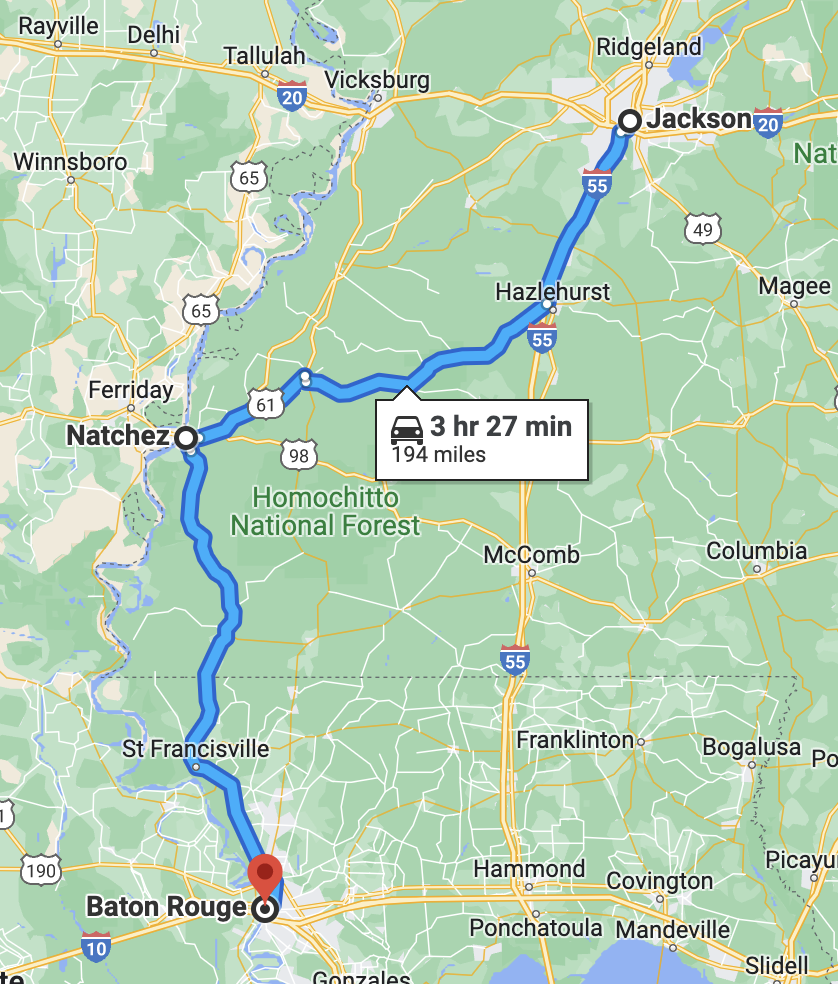
After a rather too brief exploration of Natchez, I crossed the border and headed into Baton Rouge. My newly minted platinum elite status with Marriott got me upgraded to a Suite on a top floor. Tomorrow I will explore Baton Rouge.
Another stop in Natchez was the Natchez Museum of African American Culture and History . This museum is small, but well curated. The exhibits laid out in great detail the history of Natchez , and rooms were also devoted to African art and culture and successful and important people who came from Natchez. We viewed a short video about the history of Natchez, and then Bobby, who was working at the museum, came in and expanded on various subjects and took questions. Bobby was clearly both passionate and knowledgeable about the subject. He was particularly interested in highlighting the African American experience in a region that had historically been known for its colonial culture and Antebellum homes. He wanted us to know that Natchez was and continues to be one of the most progressive and integrated cities in Mississippi.
As mentioned in yesterday’s blog post, Natchez was the site of various colonial rules, the French, British and Spanish, and eventually home to the infamous Forks of the Road Slave Market . Many of the slaves sold at this market had been purchased less expensively from Islands in the Atlantic rather the continent of Africa .
The region also pioneered, and had one of the most prolific, cotton industries in the South. Natchez was the origin of the Natchez Trace overland route, a Native American trail that followed a path established by migrating buffalo, which ran from Natchez to Nashville through what are now Mississippi, Alabama, and Tennessee. It was a major thoroughfare for commerce until steamboats enabled transport upstream on the Mississippi River. You can now drive the entire trace.
Natchez was also unusual in that it boasted a substantial number of free persons of color during the era of slavery. Many of these individuals were the offspring of white plantation owners and either enslaved or emancipated black women. The children benefited from paternal inheritances or business opportunities afforded them by their paternal families.
There is much more to the very nuanced history of Natchez and the surrounding region which, if you are interested, you can read in the links. I also learned of a book by Antoine-Simon Le Page du Pratz , a French ethnographer, historian, and naturalist, who lived in Louisiana in the mid-1700s. He learned the Natchez language and befriended native leaders. In his writings he apparently gives lengthy descriptions of Natchez society and its culture. His book is considered a main source of reliable information about the Natchez during that period.
After a rather too brief exploration of Natchez, I crossed the border and headed into Baton Rouge. My newly minted platinum elite status with Marriott got me upgraded to a Suite on a top floor. Tomorrow I will explore Baton Rouge.

61 photo galleries
50 States
- Big Sur
- Salinas
- Laguna Beach
- San Diego
- California
- Grand Canyon
- Sedona
- Utah
- Syracuse
- Moab
- Denver
- Manitou Springs
- Calhan
- Mesa Verde
- Los Alamos
- Santa Fe
- Carlsbad
- New Mexico
- Eureka Springs
- Little Rock
- Birmingham
- Jackson
- Lottie
- Ten Thousand Islands
- Jerome
- Savannah
- White
- Asheville
- Sandstone Falls
- Baltimore
- Timonium
- Maryland
- Berlin
- Milton
- Smyrna
- Ocean City
- Detroit
- Upper Peninsula of Michigan
- Michigan
- Herod
- Ozark
- Two Harbors
- Carlton
- Madison County
- Oakley
- Valentine
- South Dakota
- United States
- Yellowstone National Park
- Lima
- Idaho
- Port Townsend
- Lincoln City
- Newport
- San Francisco