Lincoln
I started the day dropping of Lucy II at the Firestone Complete Auto Care , conveniently located a block away from my hotel. Kenny, who helped me yesterday, was working on a Sunday morning and greeted me. They changed the oil and adjusted the tire pressure. The door check repair will have to wait until Fargo so they can order the part and adjust the appointment. It is not critical, just inconvenient. This is my fifth oil change, which means I have traveled 25,000 miles. I still have not hit 200K on my 2005 vehicle. I likely will before I finish the trip.
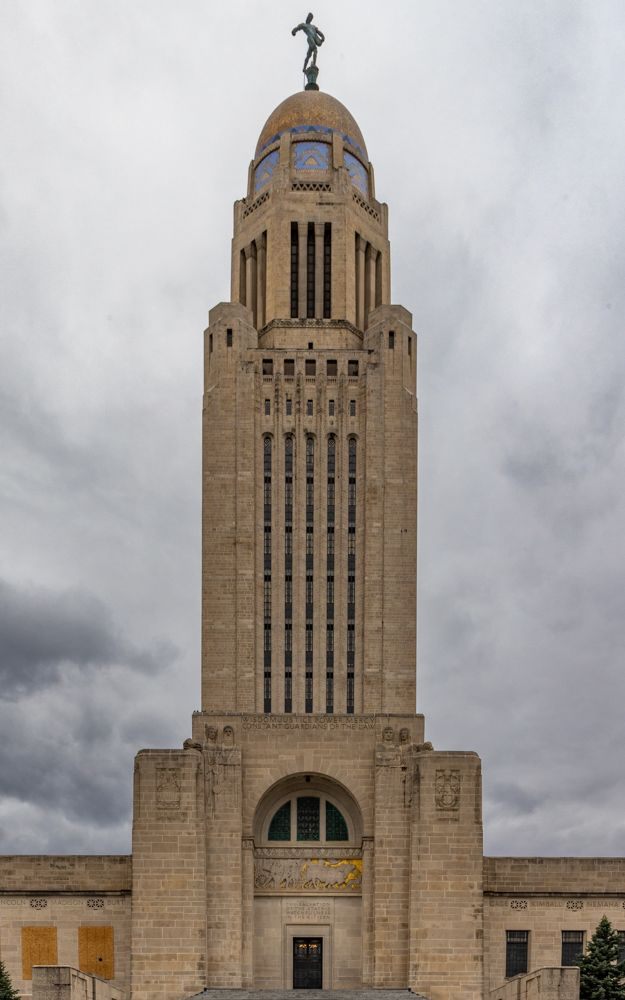
Not much is open on this cloudy/rainy Sunday in Lincoln, so I will use today’s blog post to review Nebraska history. Nebraska is not called the Cornhusker state for nothing. It is formally part of the midwest breadbasket and the majority of the land visible from any road is acres and acres of cornfields.
I have visited Nebraska a couple of times previously. The first was with my Father when we drove cross-country from California to Massachusetts for my graduate school. He arrived as a displaced person after WWII and was placed in Nebraska where he completed his engineering degree at the University of Nebraska. We stopped at the university at that time and, although things had changed considerably in the intervening decades, he still enjoyed the visit. In researching the history of Nebraska for this blog, I ran across a series on displaced persons in Nebraska, which apparently was a center for receiving displaced persons and had a committee to administer sponsorships and placements. The free version of this interesting article is found in three parts here , here and here . I also visited Nebraska once for work many years ago at Offutt AFB .
The Nebraska History Museum did a great job on documenting both the pre-history and pre-colonial history of Nebraska. Actually, this was their strength as they have a great archeology department. They are in the process of redoing their documentation of the history after the arrival of European settlers, so much of that information comes from the Interwebs .
So called Peleoindians lived in what is now present-day Nebraska at least as early as 13,000 years ago. About 2500 years ago, a wave of immigration brought Woodland Cultures of the Midwest. These people brought new ideas and technology that included farming, building and weapons. About 1,000 years ago, two additional waves of immigration swept across the Central Plains. One large group, the Central Plains Tradition is the likely forebears to the Pawnee, Wichita and Arikara, and another group, the Oneota, were probably the distant ancestors of tribes such as the loway, Otoe, Ponca, Omaha, Winnebago, Kansa, Missouria, Osage and Quapaw. Then, about 600-700 years ago, an exodus took place, with peoples moving from the Central Plains back to the midwest and up to South Dakota, as well as South and West. It is not clear why this happened, but conflict with other bands of American Indians may have been one reason. The arrival of Europeans in the 1600 impacted Native culture in every way, ultimately with disastrous consequences. As had become the pattern, within less than 150 years, tribes living in Nebraska were decimated by disease, starvation and warfare.
In 1682, René-Robert Cavelier, Sieur de La Salle claimed the area when he named all the territory drained by the Mississippi River and its tributaries for France the Louisiana Territory. In 1762, by the Treaty of Fontainebleau after France's defeat by Great Britain in the Seven Years' War, France ceded its lands west of the Mississippi River to Spain, causing the future State of Nebraska to fall under the rule of New Spain, otherwise based in Mexico and the Southwest.
In 1803, the U.S. purchased the Louisiana Territory from France. In 1812, President James Madison signed a bill creating the Missouri Territory which included the present-day state of Nebraska. In 1842, John C. Frémont, who explored the Platte River country with Kit Carson, used the Otoe word Nebrathka to designate the Platte River. Platte derives from the French word for "flat" and of Ne-brath-ka translates to "land of flat waters."
In 1854, the Territory of Nebraska was formed as part of the Kansas–Nebraska Act. The Nebraska Territory was settled extensively under the Homestead Act of 1862. Perhaps because it was created rather than originated organically, Nebraska did not grow up around a river per se. Omaha is on the Missouri River at the eastern edge of the state, and that location may have facilitated the growth of the city; but steamboat trade was not requisite for the growth of the state. Its growth was more the result of wagon trains that trekked through the area on their way west, and further as the Union Pacific Transcontinental Railroad was constructed leading west from Omaha through the Platte Valley. It reached California in 1869. Although still a territory, Nebraska sent troops to support the Union in the Civil war.
As Congress continued to create new territories in the plains region, the boundaries of Nebraska fluctuated as neighboring territories were designated, and then as states were formed and admitted to the Union. In 1867 Colorado was split off and Nebraska, reduced in size to its modern boundaries, was admitted to the Union as the 37th U.S. state. At that time, the Capitol, which had been in Omaha, was moved to Lancaster which was renamed as Lincoln.
Some controversy ensued over Nebraska's admission as a state because of a provision in the original 1866 constitution restricting suffrage to White voters. Congress voted to admit Nebraska as a state provided that the document was updated to include all races. Of course, women were still denied the right to vote, a fact that would not change on a national level until 1920. Initially, the bill to admit Nebraska as a state was vetoed by President Andrew Johnson, but the veto was overridden by a supermajority in both Chambers of Congress. Nebraska became the first–and to this day the only–state to be admitted to the Union by means of a veto override.
Nebraska is also the only state with a nonpartisan, unicameral (single house) legislature. This effort was promoted in 1937 by Senator George Norris for its efficiency, cost-effectiveness and potential greater transparency.
In 1872, J. Sterling Morton proposed a holiday to promote the planting of trees in Nebraska. The first “Arbor Day ”—in which an estimated 1 million trees were planted—was celebrated on April 10, 1872. By 1920, 45 states had adopted the holiday.
Tonight I’m met my friends T and E for dinner. I had not seen T for literally decades. We drove the hour east to Omaha to a lovely restaurant, Gather. We had enjoyable evening catching up.
Tomorrow, I head north to Niobrara State Park.
Not much is open on this cloudy/rainy Sunday in Lincoln, so I will use today’s blog post to review Nebraska history. Nebraska is not called the Cornhusker state for nothing. It is formally part of the midwest breadbasket and the majority of the land visible from any road is acres and acres of cornfields.
I have visited Nebraska a couple of times previously. The first was with my Father when we drove cross-country from California to Massachusetts for my graduate school. He arrived as a displaced person after WWII and was placed in Nebraska where he completed his engineering degree at the University of Nebraska. We stopped at the university at that time and, although things had changed considerably in the intervening decades, he still enjoyed the visit. In researching the history of Nebraska for this blog, I ran across a series on displaced persons in Nebraska, which apparently was a center for receiving displaced persons and had a committee to administer sponsorships and placements. The free version of this interesting article is found in three parts here , here and here . I also visited Nebraska once for work many years ago at Offutt AFB .
The Nebraska History Museum did a great job on documenting both the pre-history and pre-colonial history of Nebraska. Actually, this was their strength as they have a great archeology department. They are in the process of redoing their documentation of the history after the arrival of European settlers, so much of that information comes from the Interwebs .
So called Peleoindians lived in what is now present-day Nebraska at least as early as 13,000 years ago. About 2500 years ago, a wave of immigration brought Woodland Cultures of the Midwest. These people brought new ideas and technology that included farming, building and weapons. About 1,000 years ago, two additional waves of immigration swept across the Central Plains. One large group, the Central Plains Tradition is the likely forebears to the Pawnee, Wichita and Arikara, and another group, the Oneota, were probably the distant ancestors of tribes such as the loway, Otoe, Ponca, Omaha, Winnebago, Kansa, Missouria, Osage and Quapaw. Then, about 600-700 years ago, an exodus took place, with peoples moving from the Central Plains back to the midwest and up to South Dakota, as well as South and West. It is not clear why this happened, but conflict with other bands of American Indians may have been one reason. The arrival of Europeans in the 1600 impacted Native culture in every way, ultimately with disastrous consequences. As had become the pattern, within less than 150 years, tribes living in Nebraska were decimated by disease, starvation and warfare.
In 1682, René-Robert Cavelier, Sieur de La Salle claimed the area when he named all the territory drained by the Mississippi River and its tributaries for France the Louisiana Territory. In 1762, by the Treaty of Fontainebleau after France's defeat by Great Britain in the Seven Years' War, France ceded its lands west of the Mississippi River to Spain, causing the future State of Nebraska to fall under the rule of New Spain, otherwise based in Mexico and the Southwest.
In 1803, the U.S. purchased the Louisiana Territory from France. In 1812, President James Madison signed a bill creating the Missouri Territory which included the present-day state of Nebraska. In 1842, John C. Frémont, who explored the Platte River country with Kit Carson, used the Otoe word Nebrathka to designate the Platte River. Platte derives from the French word for "flat" and of Ne-brath-ka translates to "land of flat waters."
In 1854, the Territory of Nebraska was formed as part of the Kansas–Nebraska Act. The Nebraska Territory was settled extensively under the Homestead Act of 1862. Perhaps because it was created rather than originated organically, Nebraska did not grow up around a river per se. Omaha is on the Missouri River at the eastern edge of the state, and that location may have facilitated the growth of the city; but steamboat trade was not requisite for the growth of the state. Its growth was more the result of wagon trains that trekked through the area on their way west, and further as the Union Pacific Transcontinental Railroad was constructed leading west from Omaha through the Platte Valley. It reached California in 1869. Although still a territory, Nebraska sent troops to support the Union in the Civil war.
As Congress continued to create new territories in the plains region, the boundaries of Nebraska fluctuated as neighboring territories were designated, and then as states were formed and admitted to the Union. In 1867 Colorado was split off and Nebraska, reduced in size to its modern boundaries, was admitted to the Union as the 37th U.S. state. At that time, the Capitol, which had been in Omaha, was moved to Lancaster which was renamed as Lincoln.
Some controversy ensued over Nebraska's admission as a state because of a provision in the original 1866 constitution restricting suffrage to White voters. Congress voted to admit Nebraska as a state provided that the document was updated to include all races. Of course, women were still denied the right to vote, a fact that would not change on a national level until 1920. Initially, the bill to admit Nebraska as a state was vetoed by President Andrew Johnson, but the veto was overridden by a supermajority in both Chambers of Congress. Nebraska became the first–and to this day the only–state to be admitted to the Union by means of a veto override.
Nebraska is also the only state with a nonpartisan, unicameral (single house) legislature. This effort was promoted in 1937 by Senator George Norris for its efficiency, cost-effectiveness and potential greater transparency.
In 1872, J. Sterling Morton proposed a holiday to promote the planting of trees in Nebraska. The first “Arbor Day ”—in which an estimated 1 million trees were planted—was celebrated on April 10, 1872. By 1920, 45 states had adopted the holiday.
Tonight I’m met my friends T and E for dinner. I had not seen T for literally decades. We drove the hour east to Omaha to a lovely restaurant, Gather. We had enjoyable evening catching up.
Tomorrow, I head north to Niobrara State Park.

61 photo galleries
50 States
- Big Sur
- Salinas
- Laguna Beach
- San Diego
- California
- Grand Canyon
- Sedona
- Utah
- Syracuse
- Moab
- Denver
- Manitou Springs
- Calhan
- Mesa Verde
- Los Alamos
- Santa Fe
- Carlsbad
- New Mexico
- Eureka Springs
- Little Rock
- Birmingham
- Jackson
- Lottie
- Ten Thousand Islands
- Jerome
- Savannah
- White
- Asheville
- Sandstone Falls
- Baltimore
- Timonium
- Maryland
- Berlin
- Milton
- Smyrna
- Ocean City
- Detroit
- Upper Peninsula of Michigan
- Michigan
- Herod
- Ozark
- Two Harbors
- Carlton
- Madison County
- Oakley
- Valentine
- South Dakota
- United States
- Yellowstone National Park
- Lima
- Idaho
- Port Townsend
- Lincoln City
- Newport
- San Francisco