Hartford
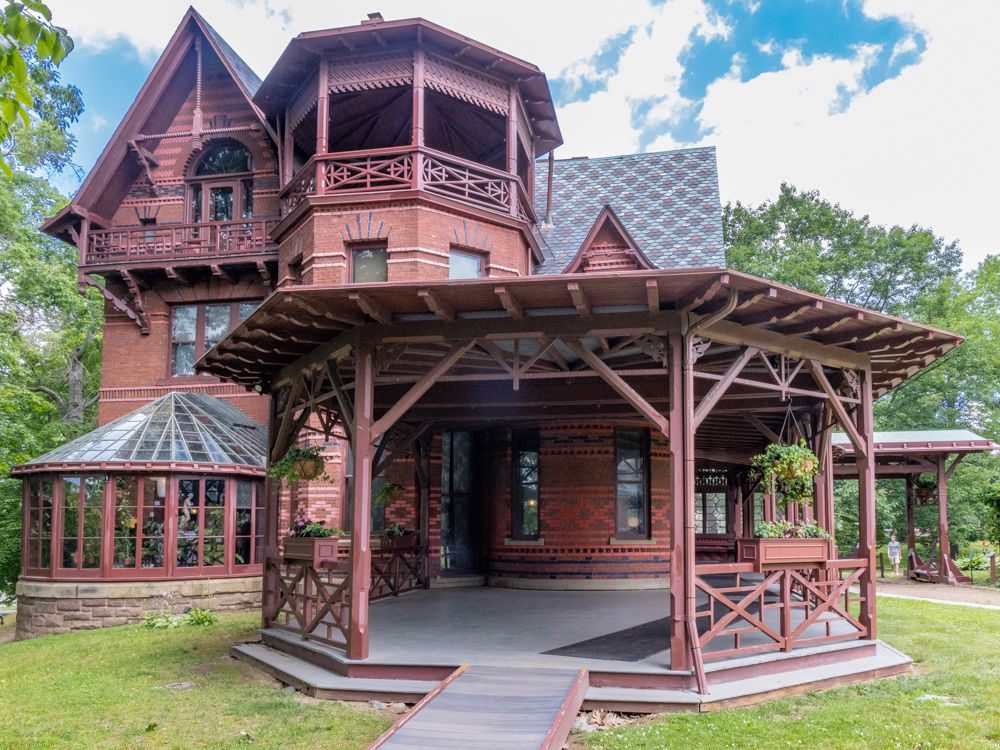
I began the day with a visit to the Mark Twain house and museum . Length alert - if you are not interested in the life and times of Mark Twain, feel free to skip the following several paragraphs.
Although Samual Clemens - Mark Twain - traveled extensively and lived in many different places, this house was where he had the longest residency and where he felt the most settled and happy. It was also where he produced some of his best and most iconic work, including The Adventures of Tom Sawyer, The Adventures of Huckleberry Finn, and Life on the Mississippi.
Harriet Beecher Stowe lived on a property adjacent to Twain and the two were friendly. I had hoped to visit the Stowe centger as well, but it is only open Friday and Saturday.
The home itself was custom built for the Twain family in the exclusive Nook Farm neighborhood of Hartford, then one of the wealthiest cities in America. New York architect Edward Tuckerman Potter, known for his church designs, built an elaborate structure, comprising 25 rooms over three stories and measuring 11,500 square feet. Louis Comfort Tiffany (recollect his contribution to the creation of the Magic Garden mural in Philadelphia), along with other designers, created a stunning interior which included walls and ceilings covered in elaborate hand-stenciled designs.
But, to review some earlier history that brought Twain to this point, it is important to understand that he was born to poor circumstances in Missouri. A formative experience occurred during boyhood summers in the 1840s when he spent summers on his uncle’s farm outside Hannibal, MO. There he was treated to stories told by an enslaved man, Daniel Quarles . Quarles largely informed the character of Jim in the Adventures of Huckleberry Finn.
After his father passed when he was still a teenager, he left school to earn money as a typesetter. It was there that he was first exposed to writing and became interested in trying his hand at it. Looking for a new adventure, he decided to become a steamboat captain on the Mississipi River. This experience and the people that he met also provided material for his future books, specifically, Life on the Mississippi. It also inspired his pen name, Mark Twain, a term describing the depth required for a steamer to safely pass. When the Civil War disrupted leisure travel on the river, Clemens headed West. After a brief and unproductive stint as a miner in Nevada, he turned to journalism and eventually continued on to California. His story, The Celebrated Jumping Frog of Calaveras County grew from a story he heard in Angels Camp, CA.
In 1867, two local newspapers, The Alta California and the New York Tribune funded his trip to Europe, the Mediterranean and the Middle East aboard the Quaker City. He wrote a collection of travel letters which were later compiled as The Innocents Abroad. This trip also generated my favorite Twain Quote, “Travel is fatal to prejudice, bigotry, and narrow-mindedness, and many of our people need it sorely on these accounts.” This quote is ever more relevant in today’s world. It was on this trip that he met fellow passenger Charles Langdon, whose sister, Olivia, eventually became Twain’s wife.
Although Twain grew up with an acceptance of slavery and a dismissiveness of Native Americans, his attitudes changed radically over his life. This was due both to his extensive travel, but also due to the attitudes of his wife, who was formally educated and came from a wealthy and stridently abolitionist family in Buffalo, NY. He ultimately became an adamant support of abolition and the emancipation of enslaved persons, and also of women’s suffrage. He was friends with Helen Keller and supported her education and publishing. He also supported Prudence Crandall for her efforts towards the education of young African-American women in Connecticut, eventually convincing the legislature to give her a pension.
George Griffin, Twain’s long-time Butler , was born an enslaved person, escaped to the Union army during the civil war and served as the personal servant to a Major General. In the Twain household, he supervised the staff, all of who were of European descent. This was obviously a very unusual situation for the time period. He was close to both Twain and the family.
Mark Twain earned a great deal of money from his writing and lectures, but made poor investments such as the Paige Compositor, a mechanical typesetter that failed because of its complexity and imprecision. To pull himself out of bankruptcy, he left his beloved house in Hartford and embarked on a world lecture tour. He earned enough during the tour to pay his creditors and reclaim his life. Unfortunately, during the tour, his daughter Susy died of spinal meningitis during a period in which she had returned to the house. Twain was unable to bear living in it after that and sold the property. After the death of his wife and another daughter Jean, he eventually built himself another house in Redding CT which he called Stormfield. He was outlived only by his daughter Clara.
Twain was born shortly after an appearance of Halley's Comet in 1835, and he predicted that he would "go out with it" as well, dying about a month before the comet passed near Earth in 1910 .
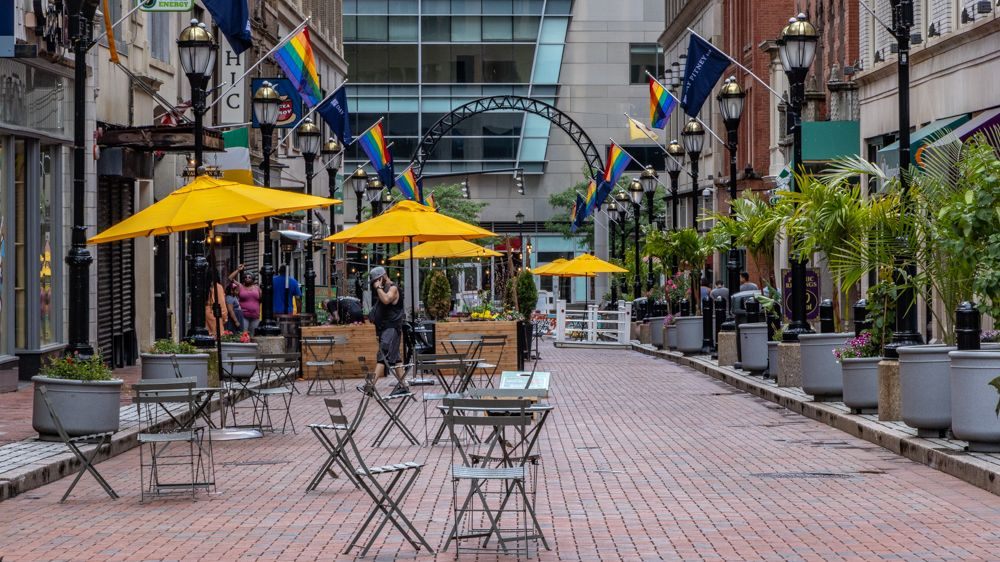
After a quick lunch stop in the historic Pratt Street neighborhood, I walked over to the Wadsworth Atheneum Museum. For a moderate-sized institution, this museum has an interesting and varied collection. As always, I am drawn to the impressionists and this museum has pieces by some of my favorites that I had not seen previously. It also has an extensive collection of paintings by the artists of the Hudson River School , which I was able to appreciate even more having just visited the region.
Tomorrow I will explore some other destinations in the Hartford area.
Although Samual Clemens - Mark Twain - traveled extensively and lived in many different places, this house was where he had the longest residency and where he felt the most settled and happy. It was also where he produced some of his best and most iconic work, including The Adventures of Tom Sawyer, The Adventures of Huckleberry Finn, and Life on the Mississippi.
Harriet Beecher Stowe lived on a property adjacent to Twain and the two were friendly. I had hoped to visit the Stowe centger as well, but it is only open Friday and Saturday.
The home itself was custom built for the Twain family in the exclusive Nook Farm neighborhood of Hartford, then one of the wealthiest cities in America. New York architect Edward Tuckerman Potter, known for his church designs, built an elaborate structure, comprising 25 rooms over three stories and measuring 11,500 square feet. Louis Comfort Tiffany (recollect his contribution to the creation of the Magic Garden mural in Philadelphia), along with other designers, created a stunning interior which included walls and ceilings covered in elaborate hand-stenciled designs.
But, to review some earlier history that brought Twain to this point, it is important to understand that he was born to poor circumstances in Missouri. A formative experience occurred during boyhood summers in the 1840s when he spent summers on his uncle’s farm outside Hannibal, MO. There he was treated to stories told by an enslaved man, Daniel Quarles . Quarles largely informed the character of Jim in the Adventures of Huckleberry Finn.
After his father passed when he was still a teenager, he left school to earn money as a typesetter. It was there that he was first exposed to writing and became interested in trying his hand at it. Looking for a new adventure, he decided to become a steamboat captain on the Mississipi River. This experience and the people that he met also provided material for his future books, specifically, Life on the Mississippi. It also inspired his pen name, Mark Twain, a term describing the depth required for a steamer to safely pass. When the Civil War disrupted leisure travel on the river, Clemens headed West. After a brief and unproductive stint as a miner in Nevada, he turned to journalism and eventually continued on to California. His story, The Celebrated Jumping Frog of Calaveras County grew from a story he heard in Angels Camp, CA.
In 1867, two local newspapers, The Alta California and the New York Tribune funded his trip to Europe, the Mediterranean and the Middle East aboard the Quaker City. He wrote a collection of travel letters which were later compiled as The Innocents Abroad. This trip also generated my favorite Twain Quote, “Travel is fatal to prejudice, bigotry, and narrow-mindedness, and many of our people need it sorely on these accounts.” This quote is ever more relevant in today’s world. It was on this trip that he met fellow passenger Charles Langdon, whose sister, Olivia, eventually became Twain’s wife.
Although Twain grew up with an acceptance of slavery and a dismissiveness of Native Americans, his attitudes changed radically over his life. This was due both to his extensive travel, but also due to the attitudes of his wife, who was formally educated and came from a wealthy and stridently abolitionist family in Buffalo, NY. He ultimately became an adamant support of abolition and the emancipation of enslaved persons, and also of women’s suffrage. He was friends with Helen Keller and supported her education and publishing. He also supported Prudence Crandall for her efforts towards the education of young African-American women in Connecticut, eventually convincing the legislature to give her a pension.
George Griffin, Twain’s long-time Butler , was born an enslaved person, escaped to the Union army during the civil war and served as the personal servant to a Major General. In the Twain household, he supervised the staff, all of who were of European descent. This was obviously a very unusual situation for the time period. He was close to both Twain and the family.
Mark Twain earned a great deal of money from his writing and lectures, but made poor investments such as the Paige Compositor, a mechanical typesetter that failed because of its complexity and imprecision. To pull himself out of bankruptcy, he left his beloved house in Hartford and embarked on a world lecture tour. He earned enough during the tour to pay his creditors and reclaim his life. Unfortunately, during the tour, his daughter Susy died of spinal meningitis during a period in which she had returned to the house. Twain was unable to bear living in it after that and sold the property. After the death of his wife and another daughter Jean, he eventually built himself another house in Redding CT which he called Stormfield. He was outlived only by his daughter Clara.
Twain was born shortly after an appearance of Halley's Comet in 1835, and he predicted that he would "go out with it" as well, dying about a month before the comet passed near Earth in 1910 .
After a quick lunch stop in the historic Pratt Street neighborhood, I walked over to the Wadsworth Atheneum Museum. For a moderate-sized institution, this museum has an interesting and varied collection. As always, I am drawn to the impressionists and this museum has pieces by some of my favorites that I had not seen previously. It also has an extensive collection of paintings by the artists of the Hudson River School , which I was able to appreciate even more having just visited the region.
Tomorrow I will explore some other destinations in the Hartford area.

61 photo galleries
50 States
- Big Sur
- Salinas
- Laguna Beach
- San Diego
- California
- Grand Canyon
- Sedona
- Utah
- Syracuse
- Moab
- Denver
- Manitou Springs
- Calhan
- Mesa Verde
- Los Alamos
- Santa Fe
- Carlsbad
- New Mexico
- Eureka Springs
- Little Rock
- Birmingham
- Jackson
- Lottie
- Ten Thousand Islands
- Jerome
- Savannah
- White
- Asheville
- Sandstone Falls
- Baltimore
- Timonium
- Maryland
- Berlin
- Milton
- Smyrna
- Ocean City
- Detroit
- Upper Peninsula of Michigan
- Michigan
- Herod
- Ozark
- Two Harbors
- Carlton
- Madison County
- Oakley
- Valentine
- South Dakota
- United States
- Yellowstone National Park
- Lima
- Idaho
- Port Townsend
- Lincoln City
- Newport
- San Francisco