Gig Harbor (Washington State History Museum)
I spent this morning catching up with my friends C & R. I’ve know C since I was four years old, so there is a lot of history between us.
At my request, we then headed over to Tacoma to visit the Washington State History Museum. This museum is a bit long in the tooth. Like others, the displays are arranged thematically rather than chronologically. It has been explained to me that this method of organizing information is the current educational standard. I’ve never found educational standards to be particularly useful; everyone learns in different ways and I personally prefer a linear approach, or at least a linear reference. I made note sof what seemed to be the main points, then went back and accessed Wiki as well as other historical sites to cross-reference the information.
Indigenous peoples inhabited this region for thousands of years prior to Europeans exploration. It is estimated that at least 125 distinct Northwest tribes and 50 languages and dialects existed before the arrival of Euro-Americans in this region. Today, Washington contains more than 20 Indian reservations, the largest of which is for the Yakama. The principal tribes of the coastal areas include the Chinook, Lummi, Quinault, Makah, Quileute, and Snohomish; the Plateau tribes include the Klickitat, Cayuse, Nez Percé, Okanogan, Palouse, Spokane, Wenatchee, and Yakama.
The history of the west coast of America centers around different elements that that of the rest of the country. U.S. interests were dealing with Spain rather than Britain, as Spain historically owned a huge swath of southern and western North America. Threats also came from across the ocean from the West, in particular from the Russian Empire. By the Treaty of 1818 , following the War of 1812 , Great Britain and the United States established the 49th parallel as the border west of the Continental Divide of the Rocky mountains; however they agreed to joint control and occupancy of Oregon Country which covered present day Washington, Oregon and Idaho. In 1819, Spain ceded their rights north of the 42nd Parallel to the United States by Adams-Onís Treaty . The treaty also ceded Florida to the U.S (although left Texas with Spain). America could now claim contiguous land stretching from coast to coast, which was considered a critical element of the concept of manifest destiny.
In 1824, a treaty with the Russian Empire established 54°40′ north as the northern border of Oregon Country for the U.S.; a separate treaty in 1825 created the same border between Russia and the United Kingdom. Joint occupancy of Oregon Country by Britain and America was renewed, but on a year-to-year basis. In 1846, Britain and the U.S. agreed to the Oregon treaty, establishing the 49th parallel as the dividing line that would become the border between the U.S. and Canada. In 1848, the Oregon Territory, composed of present-day Washington, Oregon, and Idaho, as well as parts of Montana and Wyoming, was established. What is now the State of Washington was part of Oregon Territory from 1848 to 1853, after which it was separated from Oregon and was established as Washington Territory following the Monticello Convention .
The Pig War , so called because it was triggered by the shooting of a pig, was a confrontation in 1859 between the United States and the United Kingdom over the British–U.S. border in the San Juan Islands, between Vancouver Island (present-day Canada) and the State of Washington. In 1872, an arbitration process settled the boundary dispute from the Pig War and established the present day US–Canada border through the San Juan Islands and Gulf Islands.
When we visited Port Townsend and Fort Worden the other day, we wondered about the significance of the fort and why it was built. I’ve now learned that around the cusp of the 20th century, Fort Worden, Fort Flagler and Fort Casey were constructed to protect Puget Sound from invasion by sea. Fort Worden was located within sight of a potential (if unlikely) enemy fortification, a British Royal Navy installation on Vancouver Island in Canada. The forts were never engaged in hostilities and have been preserved as historical sites.
Granted statehood in 1889 as the 42nd state, Washington was named in honor of George Washington; it is the only U.S. state named after a president. That claim might be diluted if Washington D.C. is ever granted statehood. Early prominent industries in the state included agriculture, lumber, and mining. It is home to Mount St. Helens, which erupted in 1980, becoming the deadliest and most economically destructive volcanic event in U.S. history. The Evergreen State is the nation’s leading producer of apples and is the home of the iconic Starbucks coffee chain.
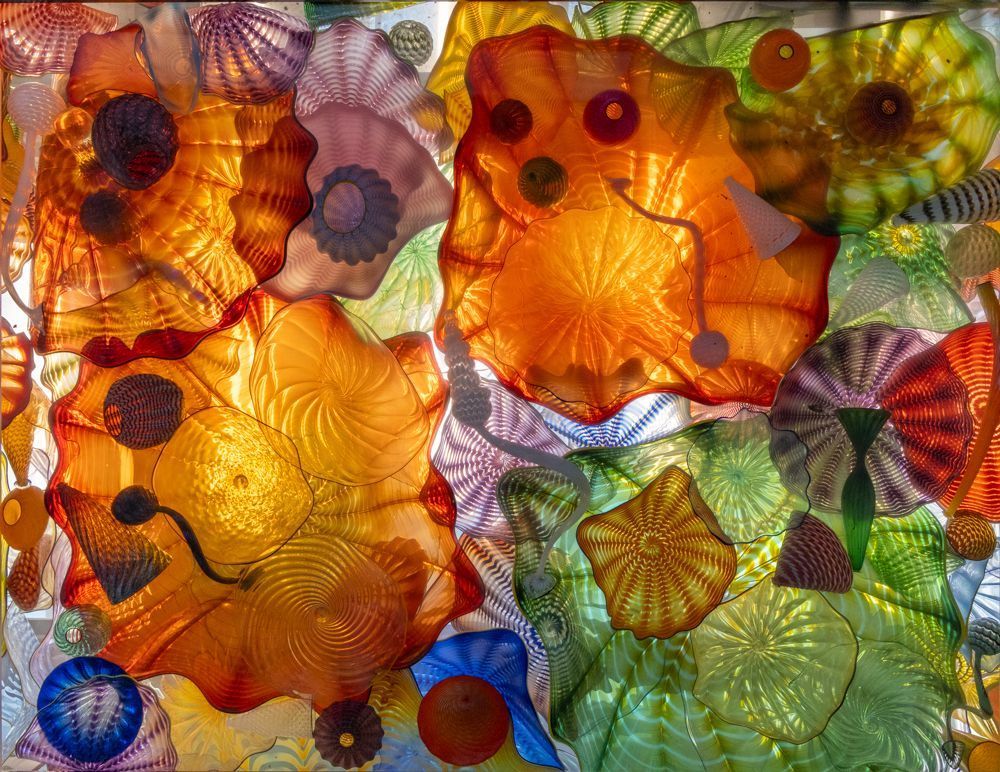
After concluding our visit to the History Museum, we walked out to the Chihuly bridge, then stopped briefly at Anthem cafe for a hot drink. We then headed over to Duke’s Seafood and Chowder restaurant for a memorable meal.
Today is my last day in Washington. Tomorrow I had south to Oregon, the last state before I touch California again.
At my request, we then headed over to Tacoma to visit the Washington State History Museum. This museum is a bit long in the tooth. Like others, the displays are arranged thematically rather than chronologically. It has been explained to me that this method of organizing information is the current educational standard. I’ve never found educational standards to be particularly useful; everyone learns in different ways and I personally prefer a linear approach, or at least a linear reference. I made note sof what seemed to be the main points, then went back and accessed Wiki as well as other historical sites to cross-reference the information.
Indigenous peoples inhabited this region for thousands of years prior to Europeans exploration. It is estimated that at least 125 distinct Northwest tribes and 50 languages and dialects existed before the arrival of Euro-Americans in this region. Today, Washington contains more than 20 Indian reservations, the largest of which is for the Yakama. The principal tribes of the coastal areas include the Chinook, Lummi, Quinault, Makah, Quileute, and Snohomish; the Plateau tribes include the Klickitat, Cayuse, Nez Percé, Okanogan, Palouse, Spokane, Wenatchee, and Yakama.
The history of the west coast of America centers around different elements that that of the rest of the country. U.S. interests were dealing with Spain rather than Britain, as Spain historically owned a huge swath of southern and western North America. Threats also came from across the ocean from the West, in particular from the Russian Empire. By the Treaty of 1818 , following the War of 1812 , Great Britain and the United States established the 49th parallel as the border west of the Continental Divide of the Rocky mountains; however they agreed to joint control and occupancy of Oregon Country which covered present day Washington, Oregon and Idaho. In 1819, Spain ceded their rights north of the 42nd Parallel to the United States by Adams-Onís Treaty . The treaty also ceded Florida to the U.S (although left Texas with Spain). America could now claim contiguous land stretching from coast to coast, which was considered a critical element of the concept of manifest destiny.
In 1824, a treaty with the Russian Empire established 54°40′ north as the northern border of Oregon Country for the U.S.; a separate treaty in 1825 created the same border between Russia and the United Kingdom. Joint occupancy of Oregon Country by Britain and America was renewed, but on a year-to-year basis. In 1846, Britain and the U.S. agreed to the Oregon treaty, establishing the 49th parallel as the dividing line that would become the border between the U.S. and Canada. In 1848, the Oregon Territory, composed of present-day Washington, Oregon, and Idaho, as well as parts of Montana and Wyoming, was established. What is now the State of Washington was part of Oregon Territory from 1848 to 1853, after which it was separated from Oregon and was established as Washington Territory following the Monticello Convention .
The Pig War , so called because it was triggered by the shooting of a pig, was a confrontation in 1859 between the United States and the United Kingdom over the British–U.S. border in the San Juan Islands, between Vancouver Island (present-day Canada) and the State of Washington. In 1872, an arbitration process settled the boundary dispute from the Pig War and established the present day US–Canada border through the San Juan Islands and Gulf Islands.
When we visited Port Townsend and Fort Worden the other day, we wondered about the significance of the fort and why it was built. I’ve now learned that around the cusp of the 20th century, Fort Worden, Fort Flagler and Fort Casey were constructed to protect Puget Sound from invasion by sea. Fort Worden was located within sight of a potential (if unlikely) enemy fortification, a British Royal Navy installation on Vancouver Island in Canada. The forts were never engaged in hostilities and have been preserved as historical sites.
Granted statehood in 1889 as the 42nd state, Washington was named in honor of George Washington; it is the only U.S. state named after a president. That claim might be diluted if Washington D.C. is ever granted statehood. Early prominent industries in the state included agriculture, lumber, and mining. It is home to Mount St. Helens, which erupted in 1980, becoming the deadliest and most economically destructive volcanic event in U.S. history. The Evergreen State is the nation’s leading producer of apples and is the home of the iconic Starbucks coffee chain.
After concluding our visit to the History Museum, we walked out to the Chihuly bridge, then stopped briefly at Anthem cafe for a hot drink. We then headed over to Duke’s Seafood and Chowder restaurant for a memorable meal.
Today is my last day in Washington. Tomorrow I had south to Oregon, the last state before I touch California again.
61 photo galleries
50 States
- Big Sur
- Salinas
- Laguna Beach
- San Diego
- California
- Grand Canyon
- Sedona
- Utah
- Syracuse
- Moab
- Denver
- Manitou Springs
- Calhan
- Mesa Verde
- Los Alamos
- Santa Fe
- Carlsbad
- New Mexico
- Eureka Springs
- Little Rock
- Birmingham
- Jackson
- Lottie
- Ten Thousand Islands
- Jerome
- Savannah
- White
- Asheville
- Sandstone Falls
- Baltimore
- Timonium
- Maryland
- Berlin
- Milton
- Smyrna
- Ocean City
- Detroit
- Upper Peninsula of Michigan
- Michigan
- Herod
- Ozark
- Two Harbors
- Carlton
- Madison County
- Oakley
- Valentine
- South Dakota
- United States
- Yellowstone National Park
- Lima
- Idaho
- Port Townsend
- Lincoln City
- Newport
- San Francisco