Fort Wayne 2
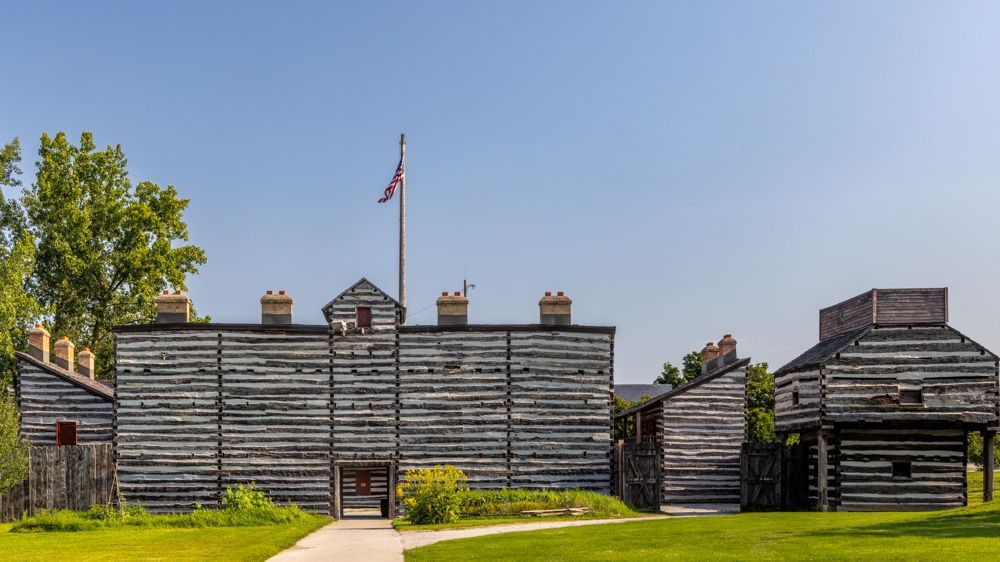
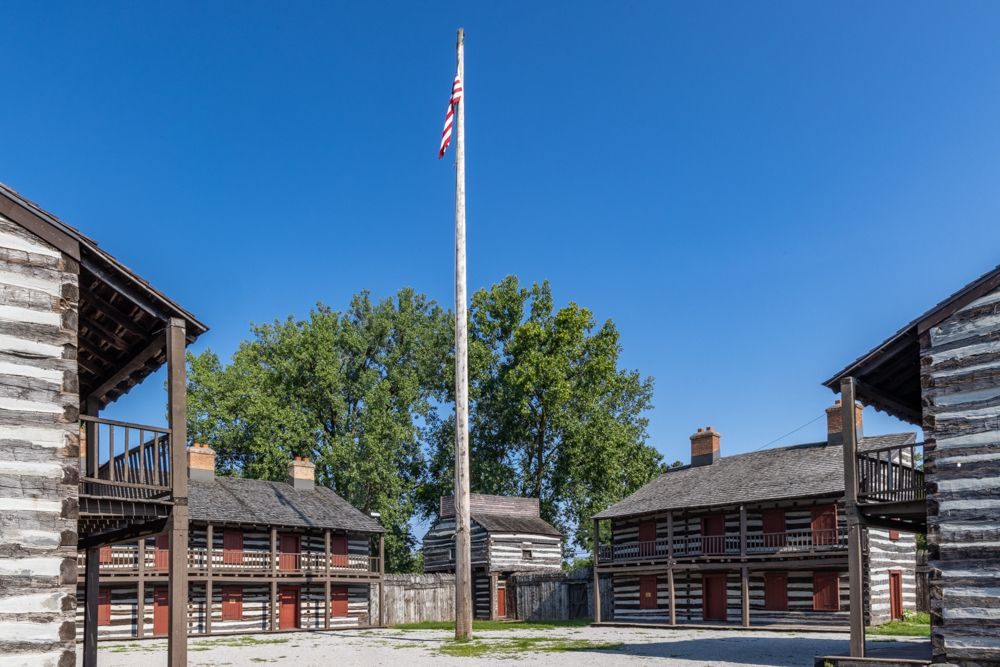
This morning my first destination was The Old Fort. I have to admit, when I looked across the bridge yesterday, I assumed that what I now know to be the Fort Wayne water filtration plant was the fort. It is a far larger and more impressive stone structure. The fort, as it turns out, is a reconstruction of some far less impressive log buildings. A couple of frustrations - the fort is listed as being open 10-5 Tue-Sun. In actual fact, the buildings are in an easily accessible park and there is no barrier or visitor center. I’m not sure what the hours refer to. Second, the only information at the location is the history of the reconstruction, nothing about the actual history of the fort. It was not a very satisfying visit.
The only destination left on my agenda was the Fort Wayne Museum of Art . This small museum has a few nicely curated exhibits. Poetry in Painting: Scenes from Fort Wayne’s Sister City Taizhou , China, was a lovely and inspiring exhibit. An American Renaissance in Fort Wayne: Muralists from the Allen County Courthouse was interesting, but frustrating, as I was not able to view the murals themselves, just a few blocks away. Landfall Press: Five Decades of Printmaking has contained wide variety of very interesting pieces. Finally, The Glass Wing contains their permanent collection of studio glass, always a pleasure.
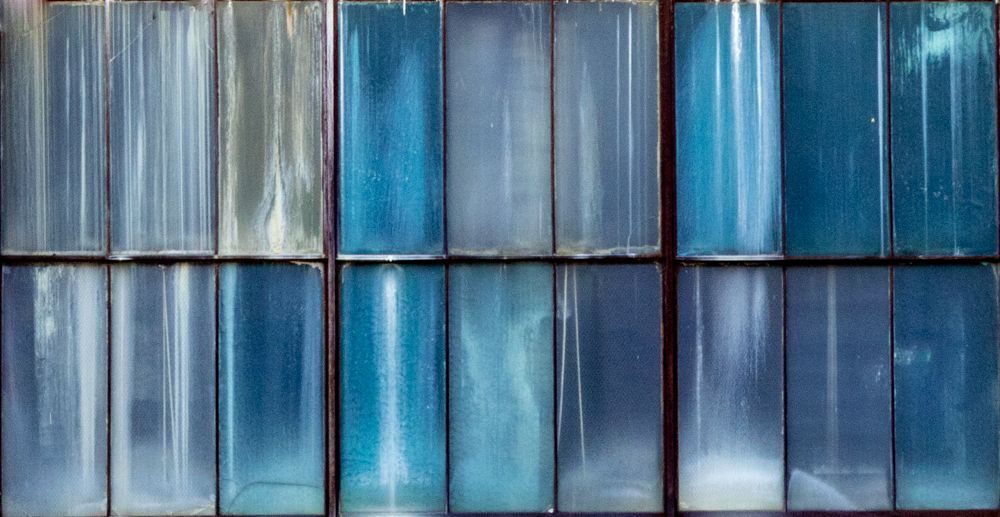
I then walked over to The Electric Works , formerly the GE plant , to grab some lunch in their food court. To recap some history, in 1883 Fort Wayne Jenney Electric Light Company was founded by Ranald T. McDonald and James Jenney. Around the turn of the century, Thomas Edison’s fledgling General Electric Co. acquired the business. By 1944, at the height of WWII, the plant employed about a third of Fort Wayne’s workforce producing electric motors, electrical transformers and other electronic items. In 2015, GE closed the campus to stay competitive in a rapidly changing marketplace. The campus was quickly acquired and reimagined as a mixed-use development.
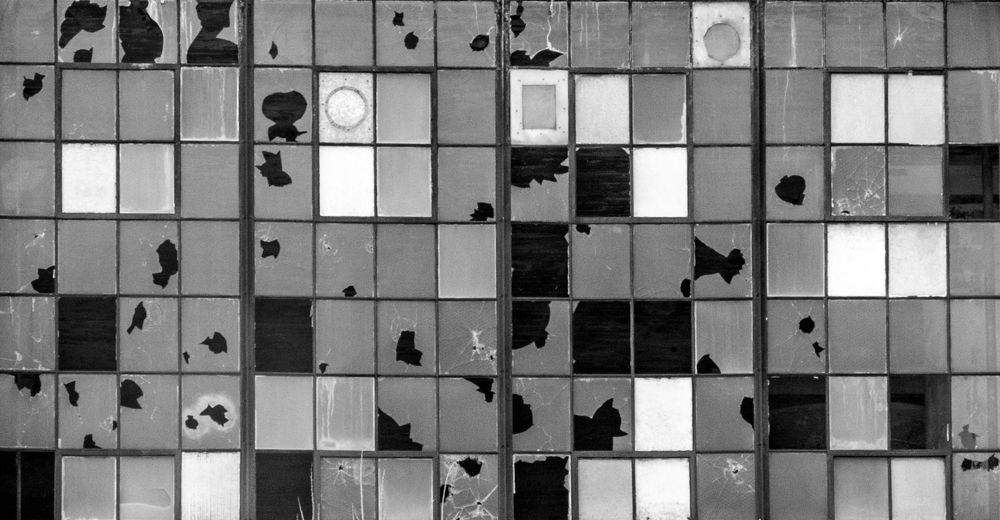
Over lunch I thought about how this one building embodies the story of Fort Wayne. Like other cities that experienced a boom during the Industrial Revolution, it also experienced a bust when technologies were modernized and old plants whose infrastructure was no longer justifiable were often closed. These plants - whether they were coal, steel, fiber or later electronics - often employed and supported a majority of the local population; and their closure left whole communities, towns, cities and states jobless and without a safety net. Fort Wayne, like other cities in a similar situation, is slowly reinventing itself and adapting to a current reality. The process seems to be slower here. Walking around, I see many abandoned industrial buildings, still awaiting repurposing. I also see a large amount of construction, presumably part of the modernization of the city.
The small downtown area, whose historic buildings have, fortunately, been preserved, quickly gives way to a small belt of suburbs (some new, some that look more run down), that quickly turn into strip malls, which give way to rural farm land. Lots of corn is growing and I’m quite sure that will be a theme over the next few midwest states.
Tomorrow I drive over to Indianapolis, which I anticipated will have a completely different vibe. I’m heading straight into the heat dome blanketing the midwest. Temperatures are expected to be in the mid to high 90s.
The only destination left on my agenda was the Fort Wayne Museum of Art . This small museum has a few nicely curated exhibits. Poetry in Painting: Scenes from Fort Wayne’s Sister City Taizhou , China, was a lovely and inspiring exhibit. An American Renaissance in Fort Wayne: Muralists from the Allen County Courthouse was interesting, but frustrating, as I was not able to view the murals themselves, just a few blocks away. Landfall Press: Five Decades of Printmaking has contained wide variety of very interesting pieces. Finally, The Glass Wing contains their permanent collection of studio glass, always a pleasure.
I then walked over to The Electric Works , formerly the GE plant , to grab some lunch in their food court. To recap some history, in 1883 Fort Wayne Jenney Electric Light Company was founded by Ranald T. McDonald and James Jenney. Around the turn of the century, Thomas Edison’s fledgling General Electric Co. acquired the business. By 1944, at the height of WWII, the plant employed about a third of Fort Wayne’s workforce producing electric motors, electrical transformers and other electronic items. In 2015, GE closed the campus to stay competitive in a rapidly changing marketplace. The campus was quickly acquired and reimagined as a mixed-use development.
Over lunch I thought about how this one building embodies the story of Fort Wayne. Like other cities that experienced a boom during the Industrial Revolution, it also experienced a bust when technologies were modernized and old plants whose infrastructure was no longer justifiable were often closed. These plants - whether they were coal, steel, fiber or later electronics - often employed and supported a majority of the local population; and their closure left whole communities, towns, cities and states jobless and without a safety net. Fort Wayne, like other cities in a similar situation, is slowly reinventing itself and adapting to a current reality. The process seems to be slower here. Walking around, I see many abandoned industrial buildings, still awaiting repurposing. I also see a large amount of construction, presumably part of the modernization of the city.
The small downtown area, whose historic buildings have, fortunately, been preserved, quickly gives way to a small belt of suburbs (some new, some that look more run down), that quickly turn into strip malls, which give way to rural farm land. Lots of corn is growing and I’m quite sure that will be a theme over the next few midwest states.
Tomorrow I drive over to Indianapolis, which I anticipated will have a completely different vibe. I’m heading straight into the heat dome blanketing the midwest. Temperatures are expected to be in the mid to high 90s.
61 photo galleries
50 States
- Big Sur
- Salinas
- Laguna Beach
- San Diego
- California
- Grand Canyon
- Sedona
- Utah
- Syracuse
- Moab
- Denver
- Manitou Springs
- Calhan
- Mesa Verde
- Los Alamos
- Santa Fe
- Carlsbad
- New Mexico
- Eureka Springs
- Little Rock
- Birmingham
- Jackson
- Lottie
- Ten Thousand Islands
- Jerome
- Savannah
- White
- Asheville
- Sandstone Falls
- Baltimore
- Timonium
- Maryland
- Berlin
- Milton
- Smyrna
- Ocean City
- Detroit
- Upper Peninsula of Michigan
- Michigan
- Herod
- Ozark
- Two Harbors
- Carlton
- Madison County
- Oakley
- Valentine
- South Dakota
- United States
- Yellowstone National Park
- Lima
- Idaho
- Port Townsend
- Lincoln City
- Newport
- San Francisco