Des Moines (History day)
This morning I walked over the Iowa History Museum . I have learned to visit the history museum in each new state as they typically give a good overview and background. It is also interesting to understand the point of view of the state writing the history.
I met and spoke at length with both Bill and Brian. Bill checked me in and was interested in ensuring I had a good experience. He even came to find me partway through my visit. They have kept the museum open during renovations, so some areas were closed off, some exhibits empty and there was some construction happening. I think I was literally the only visitor to the museum this morning.
Like all American states, the pre-history of Iowa begins with the indigenous peoples who occupied the area long before the arrival of European settlers. The Effigy Mound Builders (approximately 1,400 to 750 B.C.) were the first major group of pre-Columbian peoples who left traces. These mounds, built in the shapes of stylized birds and animals, are located along the Mississippi River and are now protected as a National Monument and comprise a major tourist attraction. I regret missing them, as well as other attractions along the river on this visit to IA, due to time constraints.
About 17 native tribes, among them the Ioway, Sauk, Mesquaki, Sioux, Potawatomi, Oto, and Missouri, were present in what is now Iowa at the time the first French explorers arrived. Iowa is named after the Ioway tribe. By 1830 the Potawatomi, Oto, and Missouri Indians had sold their land to the federal government, while the Sauk and Mesquaki remained in the Iowa region until 1845. The Santee Band of the Sioux was the last to negotiate a treaty with the federal government in 1851. After most Sauk and Mesquaki members had been removed from the state, some Mesquaki tribal members, along with a few Sauk, returned to hunt and fish in eastern Iowa. They were allowed to purchase back some of their original land and form a settlement (not a reservation), where they still live today. I did feel like the Native American story was somewhat lacking in the museum. It was pointed out to me that they have many artifacts, which is true, but I felt like the voice of the people themselves was somehow missing.
The first Europeans, French explorers Marquette and Jolliet , arrived in 1673. French and Spanish traders came for fur, and to mine and explore; they were generally transient. Initially the region was under French jurisdiction, then Spanish. The first settler appears to have been Julien Dubuque, a French-Canadian man who arrived at the lead mines near modern-day Dubuque in 1787. He obtained permission to mine the land from the Meskwaki, who generously stated that he could work the mines "as long as he shall please."
Iowa became part of the U.S. after the Louisiana Purchase in 1803 , but uncontested U.S. control over the region occurred only after the War of 1812 and after a series of treaties eliminated Indian claims on the state. The Black Hawk war with the Sauk, Meskwaki, and Ho-Chunk peoples resulted in their defeat, and they were forced - by treaty and otherwise - to relinquish their rights to plant, hunt or fish on about 6 million acres. Acquisition of this strip of land allowed unfettered settlement to begin in 1833. At this point in history, many of the settlers came from other states, seeking the fertile farm land found in Iowa. As well, immigrants from many different European countries came to work in the coal and lead mines. In addition to German immigrants, there was a large Swedish contingent, settlers from England, Ireland and Whales, Dutch, and the Czechs and Slovaks mentioned a few days ago. Various Latino groups also began to arrive in the 20th century primarily to work on the sugar beet farms. In addition to Amana, other utopian groups such as Icaria and New Buda came to Iowa to take advantage of the fertile soil that would allow them to be largely self-sufficient.
Though African-Americans began immigrating to Iowa in more significant numbers through the 1860s after obtaining freedom, some of the earliest immigrants would have been brought in as slaves by settlers from southern states after the Black Hawk Purchase, despite the fact that slavery never officially existed in Iowa. The absence of legally sanctioned slavery in Iowa did not mean that the state was free from discrimination, however. An 1838 Act prevented African-American settlement in Iowa unless he or she could present a "fair certificate" of "actual freedom" under the seal of a judge and give a $500 bond.
A significant event in Iowa history was precipitated by a prominent African-American, Alexander Clark. He tried unsuccessfully to keep the word "white" from the voting requirements spelled out in the state's 1857 constitution. But after the Civil War, Clark and others succeeded in removing racial voting barriers through a constitutional amendment in 1868. Significantly, Clark and his daughter Susan almost single-handedly ended the legal segregation of African Americans in lowa schools when the lowa Supreme Court ruled in 1868 in their favor in the case of Clark v. Board of Directors. The decision came 86 years before the U.S. Supreme Court reached the same conclusion in 1954 in the case of Brown v. Board of Education.
Subsistence frontier farming was replaced by commodity farming in Iowa after the construction of railroad networks in the 1850s and 1860s. Iowa was, at least formally, an abolitionist state and, interestingly, contributed the highest number of soldiers per capita to the Union army during the Civil War. The second half of the 19th century saw Iowa become an agricultural powerhouse, supplying food to the rest of the nation.
The industrialization of agriculture and the emergence of centralized commodities markets in the late 19th and 20th centuries led to a shift towards larger farms and the decline of the small family farm; this was exacerbated during the Great Depression. Industrial production became a larger part of the economy during World War II and the postwar economic boom. In the 1970s and 1980s a series of economic shocks, including the oil crisis, the 1980s farm crisis, and the Early 1980s recession led to the collapse of commodities prices, a decline in rural and state population, and rural flight. Iowa's economy rebounded in the 1990s, emerging as a modern mixed economy dominated by industry, commerce, and finance, in which agriculture is a comparatively small component. However, driving through the state, one is still treated to miles and miles of corn fields on either side.
The museum also gives a lot of space and attention to the movie industry. Field of Dreams, Bridges of Madison County, The Music Man and other movies were set and filmed in Iowa. As well it has produced more than its fair share of movie start, starting with John Wayne and continuing with Donna Reed, Johnny Carson, Clovis Leachman, Ashton Kutcher, Elijah Wood and more. And of course Grant Wood, known for his painting American Gothic (which I viewed at the Chicago Institute of Art) hails from IA.
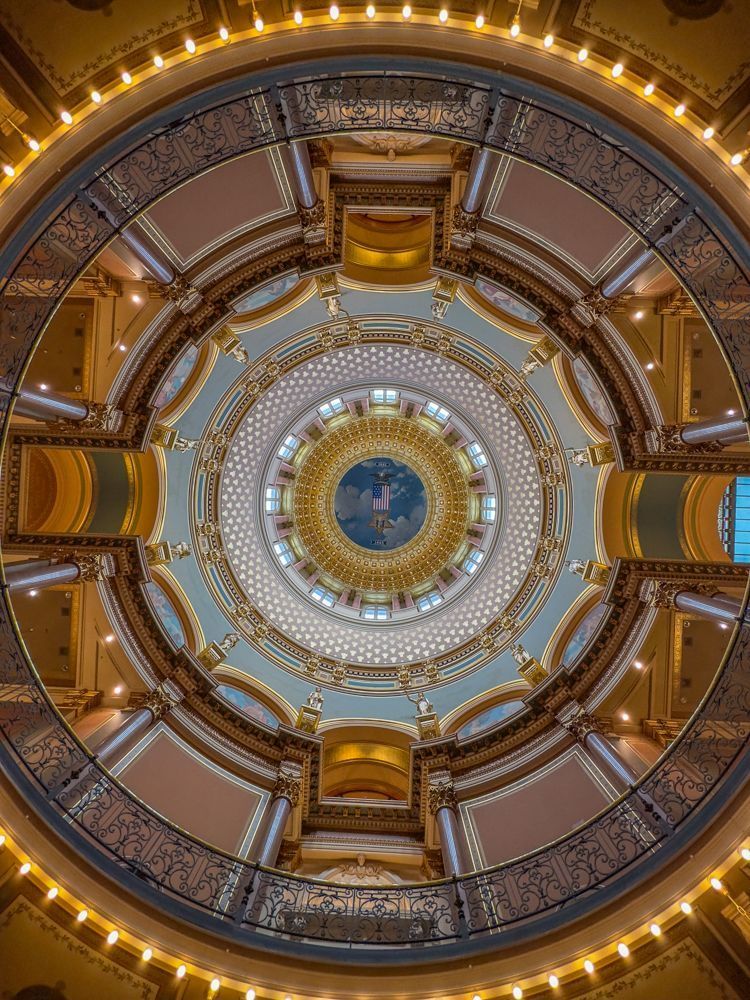
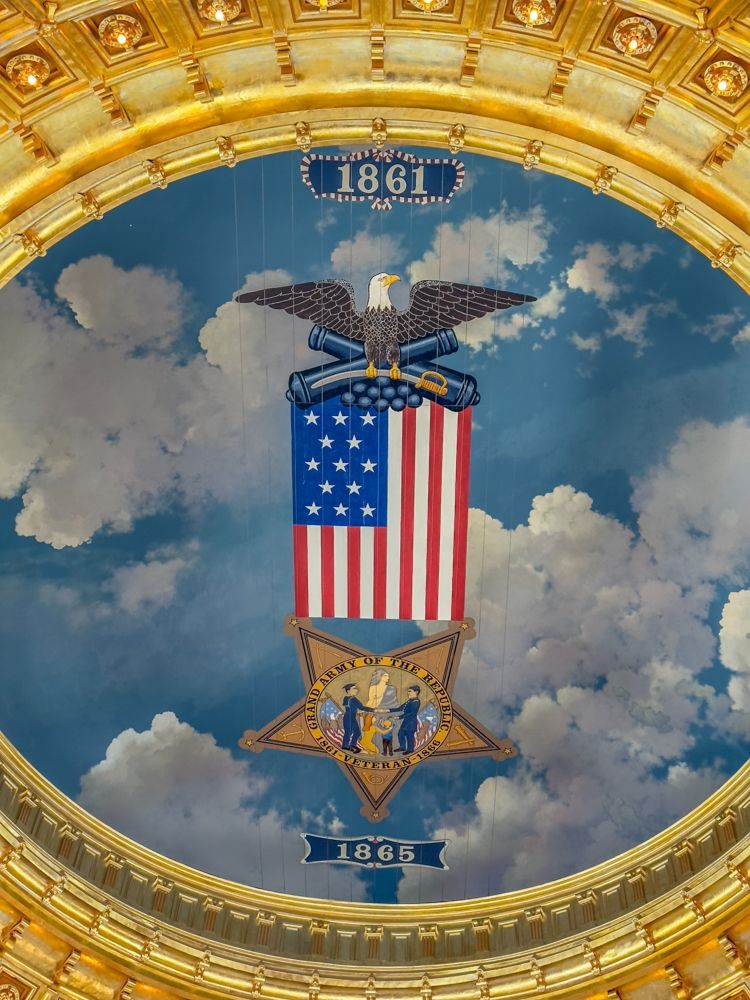
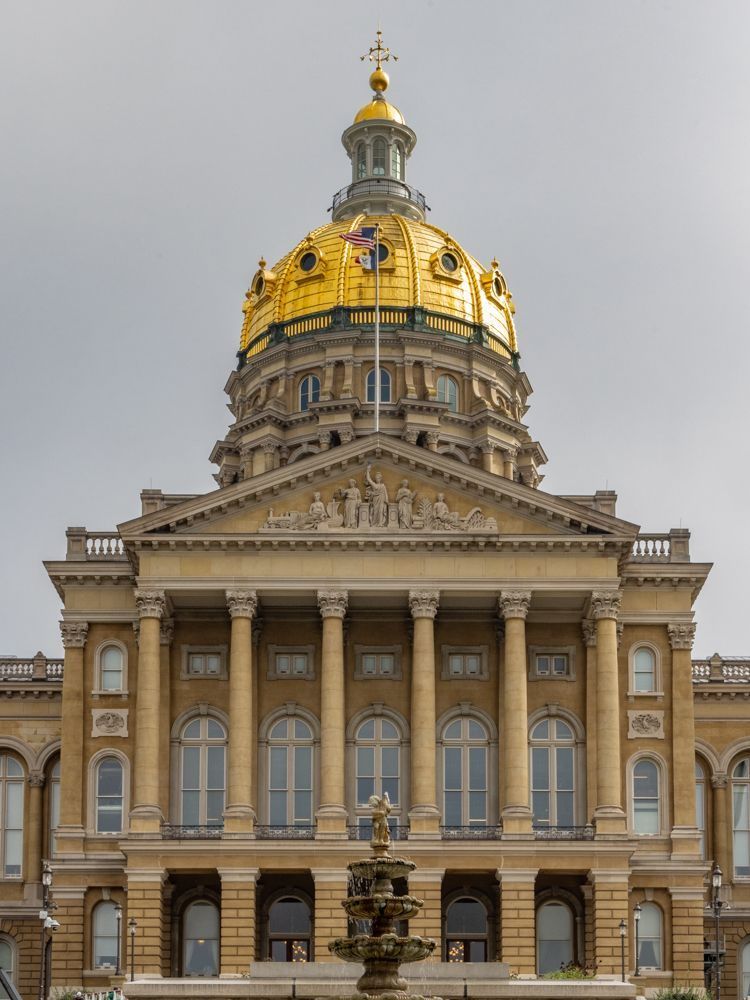
After spending a couple of hours at the museum, I walked up the street to the Iowa State Capitol. This is yet another ornate capitol building with a dome faced in gold leaf. The interior is commensurately decorated with stencils, carvings, mosaics, stained glass and plenty more gold leaf. Because I had time, I took the 90 minute tour. Karen was our guide and took us through all three floors of the Capitol building, including the old Supreme Court and the Senate and House chambers. The law library was particularly fantastical with spiral staircases leading to the upper levels. A significant event in the life of the Capitol building was a fire in 1904, in which started in the attic of the house of representatives room and also destroyed part of the Supreme Court. Ironically it started during a project to convert the lighting from gas to electricity. A worker apparently left a candle burning and it ignited papers and other detritus in the attic. This occurred in January, and the water in the fire hydrants had frozen, so the fire department was unable to contain the blaze. Someone finally had the bright idea to close the fire door in the attic and the fire eventually burned itself out.
Seeing yet another government building that cost so much to build and maintain led me to think about other possible used for that money. Yes, it is beautiful and I certainly appreciate the art, as well as the pomp and circumstance. But how many homeless people would that gold leaf feed? Just random thoughts.
I’m not yet sure what I will do tomorrow. Generally, two days is sufficient to explore a mid-size city, but I am here for three days. In retrospect, I should have stayed an extra day in Cedar Rapids and driven the MIssissipi River. Hindsight... Stay tuned.
I met and spoke at length with both Bill and Brian. Bill checked me in and was interested in ensuring I had a good experience. He even came to find me partway through my visit. They have kept the museum open during renovations, so some areas were closed off, some exhibits empty and there was some construction happening. I think I was literally the only visitor to the museum this morning.
Like all American states, the pre-history of Iowa begins with the indigenous peoples who occupied the area long before the arrival of European settlers. The Effigy Mound Builders (approximately 1,400 to 750 B.C.) were the first major group of pre-Columbian peoples who left traces. These mounds, built in the shapes of stylized birds and animals, are located along the Mississippi River and are now protected as a National Monument and comprise a major tourist attraction. I regret missing them, as well as other attractions along the river on this visit to IA, due to time constraints.
About 17 native tribes, among them the Ioway, Sauk, Mesquaki, Sioux, Potawatomi, Oto, and Missouri, were present in what is now Iowa at the time the first French explorers arrived. Iowa is named after the Ioway tribe. By 1830 the Potawatomi, Oto, and Missouri Indians had sold their land to the federal government, while the Sauk and Mesquaki remained in the Iowa region until 1845. The Santee Band of the Sioux was the last to negotiate a treaty with the federal government in 1851. After most Sauk and Mesquaki members had been removed from the state, some Mesquaki tribal members, along with a few Sauk, returned to hunt and fish in eastern Iowa. They were allowed to purchase back some of their original land and form a settlement (not a reservation), where they still live today. I did feel like the Native American story was somewhat lacking in the museum. It was pointed out to me that they have many artifacts, which is true, but I felt like the voice of the people themselves was somehow missing.
The first Europeans, French explorers Marquette and Jolliet , arrived in 1673. French and Spanish traders came for fur, and to mine and explore; they were generally transient. Initially the region was under French jurisdiction, then Spanish. The first settler appears to have been Julien Dubuque, a French-Canadian man who arrived at the lead mines near modern-day Dubuque in 1787. He obtained permission to mine the land from the Meskwaki, who generously stated that he could work the mines "as long as he shall please."
Iowa became part of the U.S. after the Louisiana Purchase in 1803 , but uncontested U.S. control over the region occurred only after the War of 1812 and after a series of treaties eliminated Indian claims on the state. The Black Hawk war with the Sauk, Meskwaki, and Ho-Chunk peoples resulted in their defeat, and they were forced - by treaty and otherwise - to relinquish their rights to plant, hunt or fish on about 6 million acres. Acquisition of this strip of land allowed unfettered settlement to begin in 1833. At this point in history, many of the settlers came from other states, seeking the fertile farm land found in Iowa. As well, immigrants from many different European countries came to work in the coal and lead mines. In addition to German immigrants, there was a large Swedish contingent, settlers from England, Ireland and Whales, Dutch, and the Czechs and Slovaks mentioned a few days ago. Various Latino groups also began to arrive in the 20th century primarily to work on the sugar beet farms. In addition to Amana, other utopian groups such as Icaria and New Buda came to Iowa to take advantage of the fertile soil that would allow them to be largely self-sufficient.
Though African-Americans began immigrating to Iowa in more significant numbers through the 1860s after obtaining freedom, some of the earliest immigrants would have been brought in as slaves by settlers from southern states after the Black Hawk Purchase, despite the fact that slavery never officially existed in Iowa. The absence of legally sanctioned slavery in Iowa did not mean that the state was free from discrimination, however. An 1838 Act prevented African-American settlement in Iowa unless he or she could present a "fair certificate" of "actual freedom" under the seal of a judge and give a $500 bond.
A significant event in Iowa history was precipitated by a prominent African-American, Alexander Clark. He tried unsuccessfully to keep the word "white" from the voting requirements spelled out in the state's 1857 constitution. But after the Civil War, Clark and others succeeded in removing racial voting barriers through a constitutional amendment in 1868. Significantly, Clark and his daughter Susan almost single-handedly ended the legal segregation of African Americans in lowa schools when the lowa Supreme Court ruled in 1868 in their favor in the case of Clark v. Board of Directors. The decision came 86 years before the U.S. Supreme Court reached the same conclusion in 1954 in the case of Brown v. Board of Education.
Subsistence frontier farming was replaced by commodity farming in Iowa after the construction of railroad networks in the 1850s and 1860s. Iowa was, at least formally, an abolitionist state and, interestingly, contributed the highest number of soldiers per capita to the Union army during the Civil War. The second half of the 19th century saw Iowa become an agricultural powerhouse, supplying food to the rest of the nation.
The industrialization of agriculture and the emergence of centralized commodities markets in the late 19th and 20th centuries led to a shift towards larger farms and the decline of the small family farm; this was exacerbated during the Great Depression. Industrial production became a larger part of the economy during World War II and the postwar economic boom. In the 1970s and 1980s a series of economic shocks, including the oil crisis, the 1980s farm crisis, and the Early 1980s recession led to the collapse of commodities prices, a decline in rural and state population, and rural flight. Iowa's economy rebounded in the 1990s, emerging as a modern mixed economy dominated by industry, commerce, and finance, in which agriculture is a comparatively small component. However, driving through the state, one is still treated to miles and miles of corn fields on either side.
The museum also gives a lot of space and attention to the movie industry. Field of Dreams, Bridges of Madison County, The Music Man and other movies were set and filmed in Iowa. As well it has produced more than its fair share of movie start, starting with John Wayne and continuing with Donna Reed, Johnny Carson, Clovis Leachman, Ashton Kutcher, Elijah Wood and more. And of course Grant Wood, known for his painting American Gothic (which I viewed at the Chicago Institute of Art) hails from IA.
After spending a couple of hours at the museum, I walked up the street to the Iowa State Capitol. This is yet another ornate capitol building with a dome faced in gold leaf. The interior is commensurately decorated with stencils, carvings, mosaics, stained glass and plenty more gold leaf. Because I had time, I took the 90 minute tour. Karen was our guide and took us through all three floors of the Capitol building, including the old Supreme Court and the Senate and House chambers. The law library was particularly fantastical with spiral staircases leading to the upper levels. A significant event in the life of the Capitol building was a fire in 1904, in which started in the attic of the house of representatives room and also destroyed part of the Supreme Court. Ironically it started during a project to convert the lighting from gas to electricity. A worker apparently left a candle burning and it ignited papers and other detritus in the attic. This occurred in January, and the water in the fire hydrants had frozen, so the fire department was unable to contain the blaze. Someone finally had the bright idea to close the fire door in the attic and the fire eventually burned itself out.
Seeing yet another government building that cost so much to build and maintain led me to think about other possible used for that money. Yes, it is beautiful and I certainly appreciate the art, as well as the pomp and circumstance. But how many homeless people would that gold leaf feed? Just random thoughts.
I’m not yet sure what I will do tomorrow. Generally, two days is sufficient to explore a mid-size city, but I am here for three days. In retrospect, I should have stayed an extra day in Cedar Rapids and driven the MIssissipi River. Hindsight... Stay tuned.

61 photo galleries
50 States
- Big Sur
- Salinas
- Laguna Beach
- San Diego
- California
- Grand Canyon
- Sedona
- Utah
- Syracuse
- Moab
- Denver
- Manitou Springs
- Calhan
- Mesa Verde
- Los Alamos
- Santa Fe
- Carlsbad
- New Mexico
- Eureka Springs
- Little Rock
- Birmingham
- Jackson
- Lottie
- Ten Thousand Islands
- Jerome
- Savannah
- White
- Asheville
- Sandstone Falls
- Baltimore
- Timonium
- Maryland
- Berlin
- Milton
- Smyrna
- Ocean City
- Detroit
- Upper Peninsula of Michigan
- Michigan
- Herod
- Ozark
- Two Harbors
- Carlton
- Madison County
- Oakley
- Valentine
- South Dakota
- United States
- Yellowstone National Park
- Lima
- Idaho
- Port Townsend
- Lincoln City
- Newport
- San Francisco