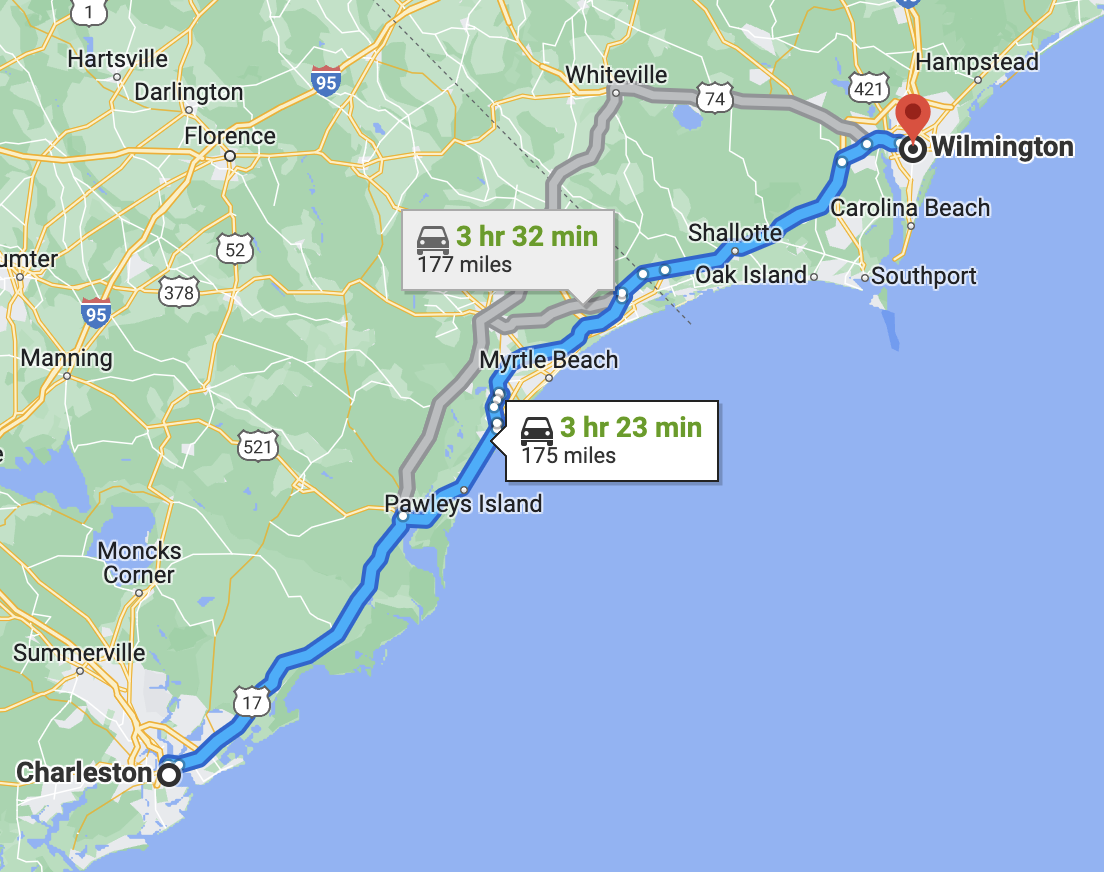
Charleston to Wilmington
I spent this morning in Charleston as I felt that I had not spent enough time in the city and learning about the history. To that end, I visited the Charleston Museum , the oldest museum in the U.S. They celebrated 250 years this year, in 2023. If you already know all of this history, or are not interested, feel free to skip the end of this post.
What is now the State of South Carolina slopes from the Blue Ridge Mountains to the Sea Coast. At one time, the sea reached much further inland, up to what is now the city of Columbia. As it receded it left sand and fossils behind. The Coast is called the Low Country because, well, it is the lower coastal plain. It is here that salt water from the sea mixes with fresh water from the inland streams, creating brackish water and tidal marshes. This ecosystem also shaped human existence in the region.
Of course the area was first inhabited by Native Americans. After receding, the sea level began to rise again, submerging many of the archeological sites, so information is limited about these early inhabitants.
Europeans first landed on what is now the South Carolina coast in the mid-16th century, first the Spanish and shortly thereafter, the British. As with many other areas of the country, raiding for slaves, warfare and disease decimated the Native tribes. In the early 18th century the Yamasee war further reduced the Native population and they lost their coast land, and were forced to move inland. As was also common in other areas, the tribes shifted alliances between colonists from different countries (Spanish, French, British) and eventually among different American factions, for example in the Civil War.
Both the French and the Spanish attempted colonization in the mid-16th century, but neither left permanent settlements. Ultimately, the British colonized the area in the mid-17th century. The Carolinas are named after King Charles II. A land grant system generated the initial distribution of lands of what was then called Carolina, prior to the division into North and South. Initially a walled city - Charles Town - was built on the tip of what is now the Charleston Peninsula. This fortification was meant to provide protection from the Spanish, French and Native tribes. The location near the harbor and rivers positioned Charleston to become a major trade center, serving as a link from the farms and plantations of the South to Europe.
Initially, deerskins obtained by barter from the Native Americans were a significant export. Lumber from the long-leaf pine forests was also exported. The first successful agricultural product was Indigo , a crop that produced the popular blue dye used in textiles. Eliza Lucas Pinkney developed a strain that grew well in the region and became a major export from the colony. The Revolutionary War disrupted the crop and American independence ultimately caused its local demise. Simultaneously, rice cultivation because a dominant cash crop in the region. Interestingly, Carolinian plantation owners particularly selected slaves originating in West Africa because of their skills and knowledge about rice cultivation. Following the Civil War and Emancipation, the cost of rice production, both due to labor costs and also several natural disasters, spelled the end of the dominance of the South in producing the majority of rice grown in the U.S.
What is now called Fort Moultrie on Sullivan’s Island was a secondary target for British forces in the Revolutionary War. Although the initial battle in 1776 was won by the colonists, Charleston eventually fell and was briefly occupied by the British in 1780. By 1782, when the peace treaty was ratified, the British evacuated Charleston for good. At the war’s end, South Carolina became the eighth state to join the Union when it ratified the United States Constitution on May 23, 1788.
Of course, ultimately it was cotton that would steer the course of history for Charleston and the South. In 1794 Eli Whitney patented the cotton gin, revolutionizing the production of all cotton, including the Sea Island Cotton produced on the barrier islands in the South. Sea Island cotton was already discussed at length in my 4/19 post. But the mass production of short-staple upland cotton made it, by sheer volume, a major export. The location of Charleston as a sea port, along with the introduction of railroads, made the city a key crossroads for trade. Of course both cotton and rice depended on enslaved labor, and both crops, as well as the plantation culture, were no longer viable after Emancipation.
Especially with the growth of the cotton economy, white settlers were increasingly encroaching on fertile soils on tribal lands, and often looted their settlements and stole livestock. As discussed extensively in previous posts, the Indian Removal Act of 1830 forcibly removed almost 100,000 First Americans from their native lands and consolidated them in Eastern Oklahoma via the Trail of Tears. This included the five confederated groups living as autonomous nations in the Southeastern U.S., the Muskogee (Creek), Cherokee, Chickasaw, Choctaw and Seminole.
In 1860, South Carolina led the secession effort, and the opening shot of the Civil War was fired by Confederate Forces over Fort Sumter in 1861 as a signal to begin bombardment. The first hostile round was fired from the Palmetto Guards battery at on Morris Island. Although many freed slaves supported the Confederacy war effort, they were still required to register with the police department when Union forces landed in 1863. Enslaved people had no choice but to remain with their masters throughout the conflict. But of course some were able to flee, crossing to Union lines.
Although President Abraham Lincoln issued the Emancipation Proclamation in 1863, the war dragged on. Finally, In 1865, Confederate forces, understanding they had lost the war, evacuated Charleston, causing a complete breakdown in public order. Union forces eventually restored order, and demanded that every citizen to take the Oath of Allegiance to the United States. On April 9, 1865, General Robert E. Lee surrendered his forces to General Ulysses S. Grant. On April 14, the U.S. flag was again raised at Fort Sumter. Tragically, that same evening, Abraham Lincoln was mortally wounded by John Wilkes Booth at Ford’s Theatre in Washington D.C.
After my morning history lesson, I drove up the coast to Wilmington, NC. I will explore this area tomorrow, but I will also take advantage of the newly approved second bivalent COVID booster for those 65 and older. Based on previous experience, I may well be down for the count on Sunday. Stay tuned.
What is now the State of South Carolina slopes from the Blue Ridge Mountains to the Sea Coast. At one time, the sea reached much further inland, up to what is now the city of Columbia. As it receded it left sand and fossils behind. The Coast is called the Low Country because, well, it is the lower coastal plain. It is here that salt water from the sea mixes with fresh water from the inland streams, creating brackish water and tidal marshes. This ecosystem also shaped human existence in the region.
Of course the area was first inhabited by Native Americans. After receding, the sea level began to rise again, submerging many of the archeological sites, so information is limited about these early inhabitants.
Europeans first landed on what is now the South Carolina coast in the mid-16th century, first the Spanish and shortly thereafter, the British. As with many other areas of the country, raiding for slaves, warfare and disease decimated the Native tribes. In the early 18th century the Yamasee war further reduced the Native population and they lost their coast land, and were forced to move inland. As was also common in other areas, the tribes shifted alliances between colonists from different countries (Spanish, French, British) and eventually among different American factions, for example in the Civil War.
Both the French and the Spanish attempted colonization in the mid-16th century, but neither left permanent settlements. Ultimately, the British colonized the area in the mid-17th century. The Carolinas are named after King Charles II. A land grant system generated the initial distribution of lands of what was then called Carolina, prior to the division into North and South. Initially a walled city - Charles Town - was built on the tip of what is now the Charleston Peninsula. This fortification was meant to provide protection from the Spanish, French and Native tribes. The location near the harbor and rivers positioned Charleston to become a major trade center, serving as a link from the farms and plantations of the South to Europe.
Initially, deerskins obtained by barter from the Native Americans were a significant export. Lumber from the long-leaf pine forests was also exported. The first successful agricultural product was Indigo , a crop that produced the popular blue dye used in textiles. Eliza Lucas Pinkney developed a strain that grew well in the region and became a major export from the colony. The Revolutionary War disrupted the crop and American independence ultimately caused its local demise. Simultaneously, rice cultivation because a dominant cash crop in the region. Interestingly, Carolinian plantation owners particularly selected slaves originating in West Africa because of their skills and knowledge about rice cultivation. Following the Civil War and Emancipation, the cost of rice production, both due to labor costs and also several natural disasters, spelled the end of the dominance of the South in producing the majority of rice grown in the U.S.
What is now called Fort Moultrie on Sullivan’s Island was a secondary target for British forces in the Revolutionary War. Although the initial battle in 1776 was won by the colonists, Charleston eventually fell and was briefly occupied by the British in 1780. By 1782, when the peace treaty was ratified, the British evacuated Charleston for good. At the war’s end, South Carolina became the eighth state to join the Union when it ratified the United States Constitution on May 23, 1788.
Of course, ultimately it was cotton that would steer the course of history for Charleston and the South. In 1794 Eli Whitney patented the cotton gin, revolutionizing the production of all cotton, including the Sea Island Cotton produced on the barrier islands in the South. Sea Island cotton was already discussed at length in my 4/19 post. But the mass production of short-staple upland cotton made it, by sheer volume, a major export. The location of Charleston as a sea port, along with the introduction of railroads, made the city a key crossroads for trade. Of course both cotton and rice depended on enslaved labor, and both crops, as well as the plantation culture, were no longer viable after Emancipation.
Especially with the growth of the cotton economy, white settlers were increasingly encroaching on fertile soils on tribal lands, and often looted their settlements and stole livestock. As discussed extensively in previous posts, the Indian Removal Act of 1830 forcibly removed almost 100,000 First Americans from their native lands and consolidated them in Eastern Oklahoma via the Trail of Tears. This included the five confederated groups living as autonomous nations in the Southeastern U.S., the Muskogee (Creek), Cherokee, Chickasaw, Choctaw and Seminole.
In 1860, South Carolina led the secession effort, and the opening shot of the Civil War was fired by Confederate Forces over Fort Sumter in 1861 as a signal to begin bombardment. The first hostile round was fired from the Palmetto Guards battery at on Morris Island. Although many freed slaves supported the Confederacy war effort, they were still required to register with the police department when Union forces landed in 1863. Enslaved people had no choice but to remain with their masters throughout the conflict. But of course some were able to flee, crossing to Union lines.
Although President Abraham Lincoln issued the Emancipation Proclamation in 1863, the war dragged on. Finally, In 1865, Confederate forces, understanding they had lost the war, evacuated Charleston, causing a complete breakdown in public order. Union forces eventually restored order, and demanded that every citizen to take the Oath of Allegiance to the United States. On April 9, 1865, General Robert E. Lee surrendered his forces to General Ulysses S. Grant. On April 14, the U.S. flag was again raised at Fort Sumter. Tragically, that same evening, Abraham Lincoln was mortally wounded by John Wilkes Booth at Ford’s Theatre in Washington D.C.
After my morning history lesson, I drove up the coast to Wilmington, NC. I will explore this area tomorrow, but I will also take advantage of the newly approved second bivalent COVID booster for those 65 and older. Based on previous experience, I may well be down for the count on Sunday. Stay tuned.
61 photo galleries
50 States
- Big Sur
- Salinas
- Laguna Beach
- San Diego
- California
- Grand Canyon
- Sedona
- Utah
- Syracuse
- Moab
- Denver
- Manitou Springs
- Calhan
- Mesa Verde
- Los Alamos
- Santa Fe
- Carlsbad
- New Mexico
- Eureka Springs
- Little Rock
- Birmingham
- Jackson
- Lottie
- Ten Thousand Islands
- Jerome
- Savannah
- White
- Asheville
- Sandstone Falls
- Baltimore
- Timonium
- Maryland
- Berlin
- Milton
- Smyrna
- Ocean City
- Detroit
- Upper Peninsula of Michigan
- Michigan
- Herod
- Ozark
- Two Harbors
- Carlton
- Madison County
- Oakley
- Valentine
- South Dakota
- United States
- Yellowstone National Park
- Lima
- Idaho
- Port Townsend
- Lincoln City
- Newport
- San Francisco