Cedar Rapids (Amana Colonies)
This morning I drove a half hour South to visit the Amana Colonies . I joined a tour ably led by David, whose ancestors were among the original settlers of the Colonies.
The Amana Colonies stem from a religious movement started in 1714 in Germany . They had grown displeased with the dogmatism of the Lutheran Church and began to study and adopt a particular theology called Mystic Pietism . In 1892, persecution by both the Lutheran Church and the German government eventually drove them to emmigrate as a group to the U.S. to seek religious freedom. They initially settled near Buffalo, NY, but eventually moved to their present location in a fertile valley near the Iowa River. They called themselves the Amana, a biblical term loosely meaning “remain faithful.” Under Iowa law, the Community had to incorporate as a business, so the Amana Society was founded as the governing body in 1859.
They initially operated as a completely communal society , in which the church owned everything and members worked, essentially for room and board. For eighty years, the Amana Colonies maintained an almost completely self-sufficient local economy, importing very little from the industrialized American economy. They pursued specialized crafting and farming operations that they had brought with them from Europe. They used hand, horse, wind, and water power, and made their own furniture, clothes, and other goods.
Religion was, and remains, the glue that binds the the colonies. The founders, in particular Christian Metz who led the group to the U.S., believed that G_d communicated through individuals with the "gift of inspiration", just as he did in the days of the prophets. This individual was called an “instrument” because he or she was thought to be used as a tool of G_d’s will to speak directly to his people. Over the years, a number of people apparently received the gift of inspiration, and scribe followed them around to record their utterances. This tenet is central to the Amana, and distinguishes them from other Christian religions.
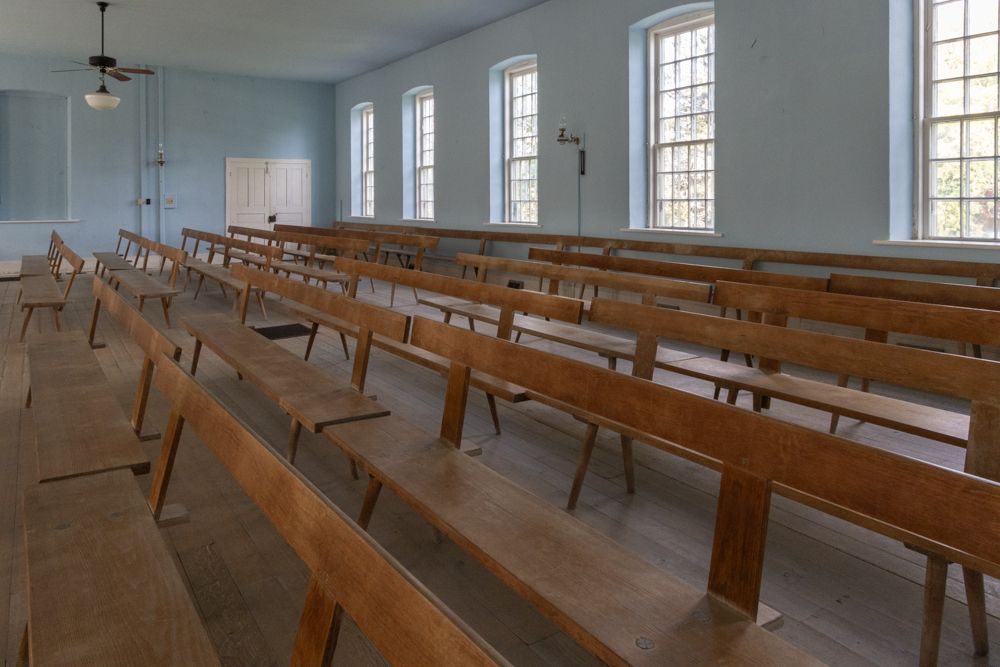
Similar to the Anabaptists (see previous posts about the Amish and Mennonites), the Amana don’t receive Baptism at birth, but rather accept it sometime later in life from the Holy Spirit, or sometimes seek a physical Baptism at another church. The Sunday service is highly proscribed, and includes teachings from the recorded words of the “instruments.” Men and women sit separately, and children are taught separately at a Sunday school so as not to disrupt the service. The leadership consists of 10 elders who rotate duties leading the service.
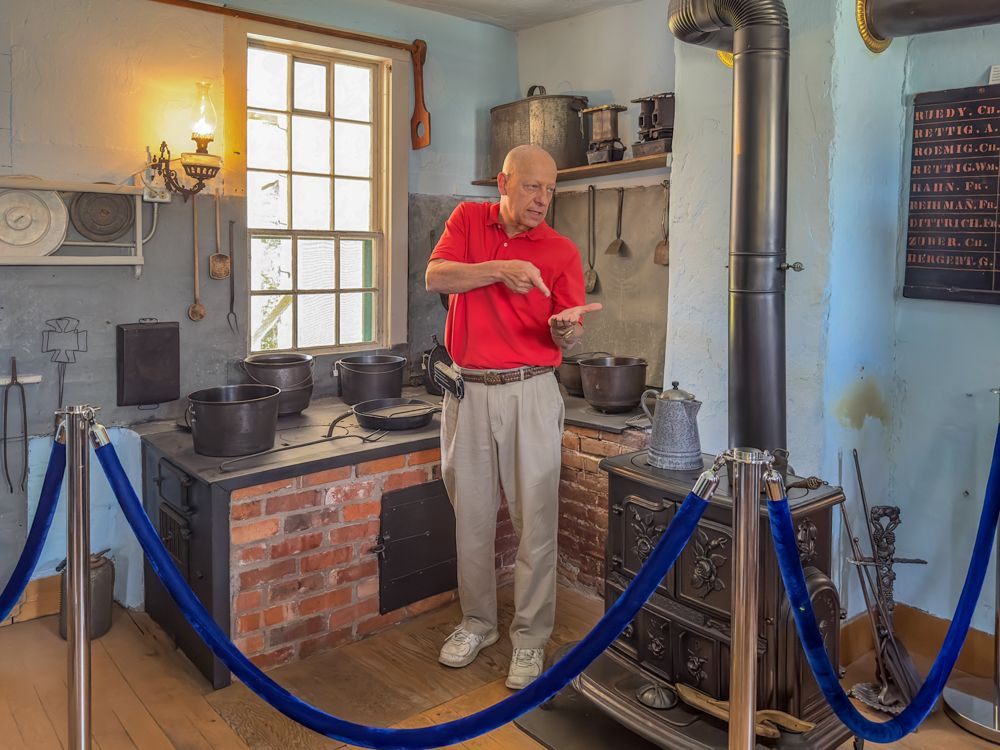
One of the hallmarks of Old Amana was the communal kitchens . Houses lacked kitchens at all, and members would gather to eat meals at one of a number of community kitchens placed throughout the villages. The communal kitchen concept eroded some time around 1900, as married residents began to eat in their own homes. Food was still cooked in the communal kitchens, but housewives would take the food home. Kitchen staff and single residents still ate in the communal kitchens.
Also, similar to the Amish and Mennonites, the Amanians are pacifists. During WWI, they paid the $310.00 fee for each male of age be excused form military service. During WWII, they agreed to perform military service working in domestic positions, but still declined to pick up arms. A few young men, starting with the Civil War where they fought with the Union forces, left of their own accord and joined the military. Today, unlike the Anabaptists, no prohibition exists to deter young men from military service.
Also, unlike the Mennonites the Amanians consume coffee and alcohol, mostly beer and wine, brewed with German ingenuity. Oktoberfest in the Amana Colonies draws tens of thousands of visitors.
In 1931, in the wake of the Great Depression, the ruling council disclosed to the Amana Society that the villages were in dire financial condition. The Depression was particularly harsh in the Colony because a fire, started by a mill stone spark in the flour mill (see post a few days ago about the Minneapolis four mill) had badly damaged both the flour mill and the woolen mill less than ten years earlier. At the same time, Society members were beginning to seek increased secularism so that they could have more personal freedom. The Society agreed to split into two organizations. The non-profit Amana Church Society oversaw the spiritual needs of the community, while the for-profit Amana Society was incorporated as a joint-stock company. The transition was completed in 1932 and came to be known in the community as the Great Change .
The Amana colonies are known for their use of an anaerobic digester . This devices uses organic waste, including manure and industrial waste to produce fertilizer, heat for buildings and methane for generating electricity. Except for the Amana refrigeration plant, this energy source powers the entire village complex. It also serves to reduce methane emissions.
Finally, if you recognize the Amana name out of context, you have figured out that this is the same Amana that produces refrigerators and freezers. They were eventually purchased by Maytag, which was itself purchased by Whirlpool. Amana continues to manufacture Amana, JennAir, KitchenAid, Maytag and Whirlpool refrigerators at the plant, built in 1940, under a long-term lease agreement.
Tomorrow, I will head West to Des Moines.
The Amana Colonies stem from a religious movement started in 1714 in Germany . They had grown displeased with the dogmatism of the Lutheran Church and began to study and adopt a particular theology called Mystic Pietism . In 1892, persecution by both the Lutheran Church and the German government eventually drove them to emmigrate as a group to the U.S. to seek religious freedom. They initially settled near Buffalo, NY, but eventually moved to their present location in a fertile valley near the Iowa River. They called themselves the Amana, a biblical term loosely meaning “remain faithful.” Under Iowa law, the Community had to incorporate as a business, so the Amana Society was founded as the governing body in 1859.
They initially operated as a completely communal society , in which the church owned everything and members worked, essentially for room and board. For eighty years, the Amana Colonies maintained an almost completely self-sufficient local economy, importing very little from the industrialized American economy. They pursued specialized crafting and farming operations that they had brought with them from Europe. They used hand, horse, wind, and water power, and made their own furniture, clothes, and other goods.
Religion was, and remains, the glue that binds the the colonies. The founders, in particular Christian Metz who led the group to the U.S., believed that G_d communicated through individuals with the "gift of inspiration", just as he did in the days of the prophets. This individual was called an “instrument” because he or she was thought to be used as a tool of G_d’s will to speak directly to his people. Over the years, a number of people apparently received the gift of inspiration, and scribe followed them around to record their utterances. This tenet is central to the Amana, and distinguishes them from other Christian religions.
Similar to the Anabaptists (see previous posts about the Amish and Mennonites), the Amana don’t receive Baptism at birth, but rather accept it sometime later in life from the Holy Spirit, or sometimes seek a physical Baptism at another church. The Sunday service is highly proscribed, and includes teachings from the recorded words of the “instruments.” Men and women sit separately, and children are taught separately at a Sunday school so as not to disrupt the service. The leadership consists of 10 elders who rotate duties leading the service.
One of the hallmarks of Old Amana was the communal kitchens . Houses lacked kitchens at all, and members would gather to eat meals at one of a number of community kitchens placed throughout the villages. The communal kitchen concept eroded some time around 1900, as married residents began to eat in their own homes. Food was still cooked in the communal kitchens, but housewives would take the food home. Kitchen staff and single residents still ate in the communal kitchens.
Also, similar to the Amish and Mennonites, the Amanians are pacifists. During WWI, they paid the $310.00 fee for each male of age be excused form military service. During WWII, they agreed to perform military service working in domestic positions, but still declined to pick up arms. A few young men, starting with the Civil War where they fought with the Union forces, left of their own accord and joined the military. Today, unlike the Anabaptists, no prohibition exists to deter young men from military service.
Also, unlike the Mennonites the Amanians consume coffee and alcohol, mostly beer and wine, brewed with German ingenuity. Oktoberfest in the Amana Colonies draws tens of thousands of visitors.
In 1931, in the wake of the Great Depression, the ruling council disclosed to the Amana Society that the villages were in dire financial condition. The Depression was particularly harsh in the Colony because a fire, started by a mill stone spark in the flour mill (see post a few days ago about the Minneapolis four mill) had badly damaged both the flour mill and the woolen mill less than ten years earlier. At the same time, Society members were beginning to seek increased secularism so that they could have more personal freedom. The Society agreed to split into two organizations. The non-profit Amana Church Society oversaw the spiritual needs of the community, while the for-profit Amana Society was incorporated as a joint-stock company. The transition was completed in 1932 and came to be known in the community as the Great Change .
The Amana colonies are known for their use of an anaerobic digester . This devices uses organic waste, including manure and industrial waste to produce fertilizer, heat for buildings and methane for generating electricity. Except for the Amana refrigeration plant, this energy source powers the entire village complex. It also serves to reduce methane emissions.
Finally, if you recognize the Amana name out of context, you have figured out that this is the same Amana that produces refrigerators and freezers. They were eventually purchased by Maytag, which was itself purchased by Whirlpool. Amana continues to manufacture Amana, JennAir, KitchenAid, Maytag and Whirlpool refrigerators at the plant, built in 1940, under a long-term lease agreement.
Tomorrow, I will head West to Des Moines.


61 photo galleries
50 States
- Big Sur
- Salinas
- Laguna Beach
- San Diego
- California
- Grand Canyon
- Sedona
- Utah
- Syracuse
- Moab
- Denver
- Manitou Springs
- Calhan
- Mesa Verde
- Los Alamos
- Santa Fe
- Carlsbad
- New Mexico
- Eureka Springs
- Little Rock
- Birmingham
- Jackson
- Lottie
- Ten Thousand Islands
- Jerome
- Savannah
- White
- Asheville
- Sandstone Falls
- Baltimore
- Timonium
- Maryland
- Berlin
- Milton
- Smyrna
- Ocean City
- Detroit
- Upper Peninsula of Michigan
- Michigan
- Herod
- Ozark
- Two Harbors
- Carlton
- Madison County
- Oakley
- Valentine
- South Dakota
- United States
- Yellowstone National Park
- Lima
- Idaho
- Port Townsend
- Lincoln City
- Newport
- San Francisco