Bismark
Because I am back on the Canadian border, and because we’re stuck with an extra two weeks of DST, the sun does not even rise until 8:30 AM. So, in spite of the fact that the North Dakota Heritage Center and State Museum opened at 8 AM, I waited until 9 AM to head over. As far as I am concerned, the bill to switch to permanent DST that is stalled in the House can stay there. AZ and HI have the right idea with permanent standard time.
When I arrived at the museum, I was warmly greeted by Leo and Harlo at the front desk. We spent some time chatting about both my trip and the museum before I went off to peruse the exhibits. This is a very well done museum; the exhibits are clean and the text on the boards is actually legible without requiring a close-up encounter with a magnifying glass.
I started in the screening room, where a plethora of vignettes featuring Native American story tellers were available on demand. Harlo had also handed me a note with a QR code to access the hours of stories directly from the internet on my own time. These vignettes lead into an exhibit entitled On the Edge of the Wind; Native Storytellers & the Land . This was a beautifully curated exhibit, down to the background of authentic flute music. The light was subtly dimmed, adding to the atmosphere of sanctity and calm. Each story featured a different cultural element or land feature, highlighted by large images related to the story. Several stations featured on-demand stories, again relating to the specific topics. A second room housing the Innovation Gallery is also devoted to a history of the early peoples of North Dakota. It provides a more typical narrative that nicely complements the storytelling approach
A third room, the Adaptation Gallery , explores the history of North Dakota from the perspective of geology and paleontology. Like the other Plains States, the western half of North Dakota was once a primordial ocean that morphed through several different ecosystems before becoming the high plains and badlands of current existence. As such, the area is rich in fossils that help tell the ecological history of the area.
The fourth and last room, housing the Inspiration Gallery , tells the story of the State of North Dakota using themed exhibits. I was interested to learn that the majority of the early European-American settlers were of Nordic or German ancestry, with a smattering of Eastern Europeans. And of course that is reflected in the customer and culture of the region. Modern museums appear to have completely given up on timelines. While I appreciate the themed approach, my linear mind would also like a timeline in which to put everything in context. History.com gives a nice summary, and additional information can be found on the Wiki page .
The land that today makes up North Dakota first became a U.S. territory as part of the Louisiana Purchase of 1803. The region was originally part of the Minnesota and Nebraska territories, until, along with what is now South Dakota, it was organized into the Dakota Territory in 1861 . Although settlers began to arrive in earnest in response to the Homestead Act of 1862, the territory remained sparsely populated until the arrival of the railroads in the late 1800s. Relations between the two territories were not entirely congenial. Once the Dakota Territory was split into North Dakota and South Dakota, an intense rivalry developed over which state would be admitted to the union first. When the time came for their formal admission, President Benjamin Harrison selected at random which bill to sign first and did not record the order in which the bills were signed. Both states entered the Union in 1889 . Ironically, Dakota is a Sioux Indian word that translates to "friend."
After spending a couple of hours with the exhibits, and grabbing a cup of coffee at the cafe, I returned to the front desk with a couple of questions. As I was asking them, Tom, who works at the museum (I think as a curator) happened to walk up and helped to answer my questions. I wondered why, in spite of the excellent Native American exhibits, there was no land acknowledgment statement, as I have seen in other museums. Tom said that was something currently under discussion, and they were working closely with local Tribal members to address the issue. I also wondered about any African-American history in the region. Not unexpectedly, the population, both historically and present day, was and is quite small. And because of the physical distance from the events the precipitated the Civil War and subsequent Civil Rights events, the Dakotas really were on the periphery of those issues. We continued our discussion to include a wide range of topics, including politics, the environment, national events and world events. This was a very informative morning, and I enjoyed learning from all three gentlemen. It was also warm and dry which provided a nice break.
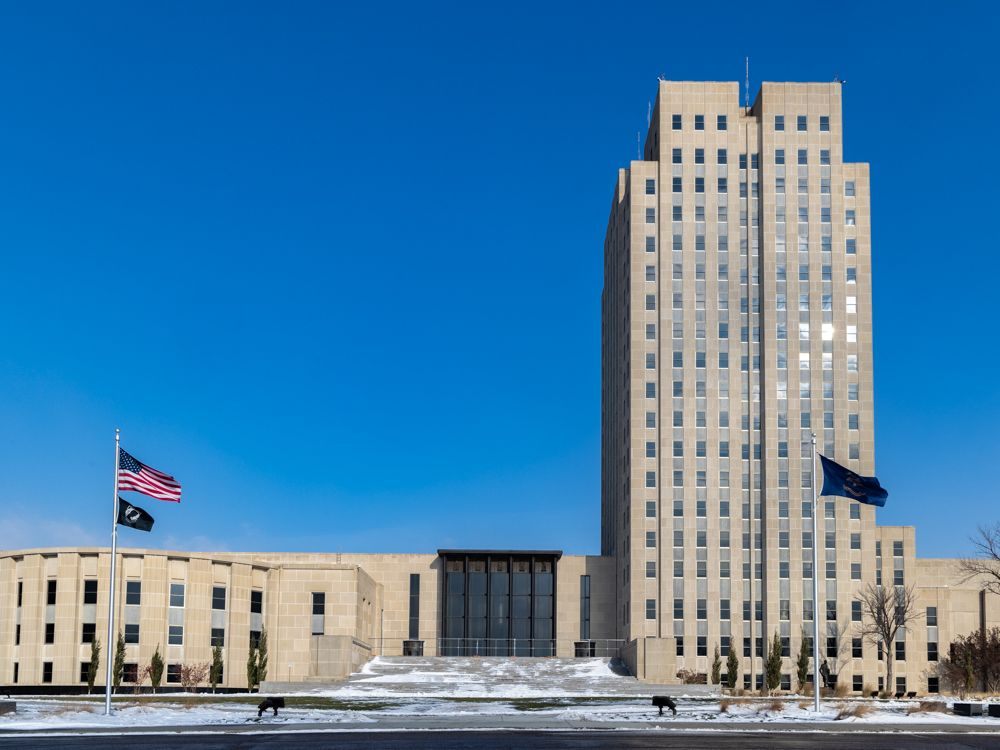
After leaving the Heritage Center, I drove around the corner to take a look at the North Dakota State Capitol building . This is the first Capitol I have seen that does not feature a Neo-classical dome. It is completely modern, square and utilitarian. The original Greek Revival building was destroyed by fire in 1930 and it was decided to rebuild on the same site in a modern style.
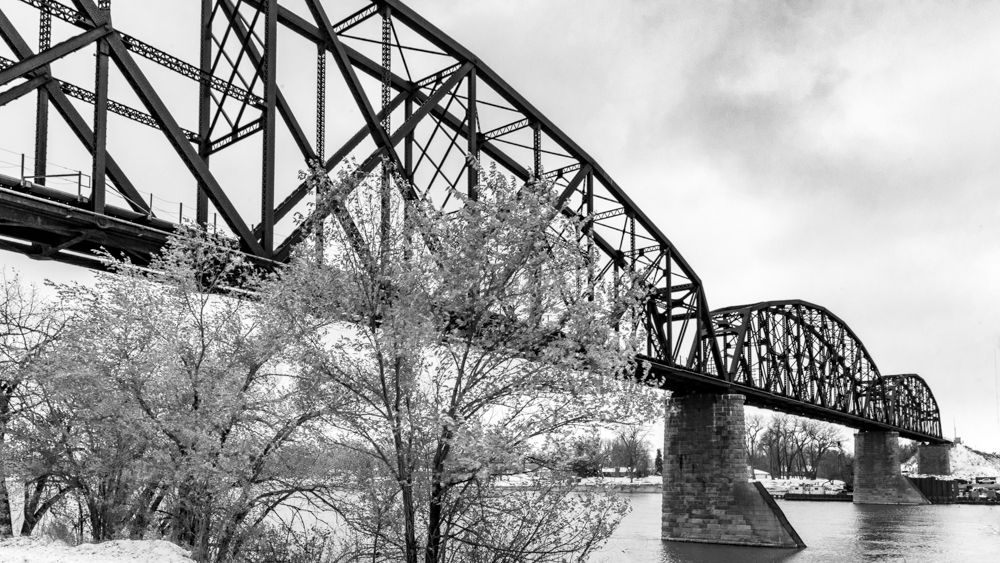
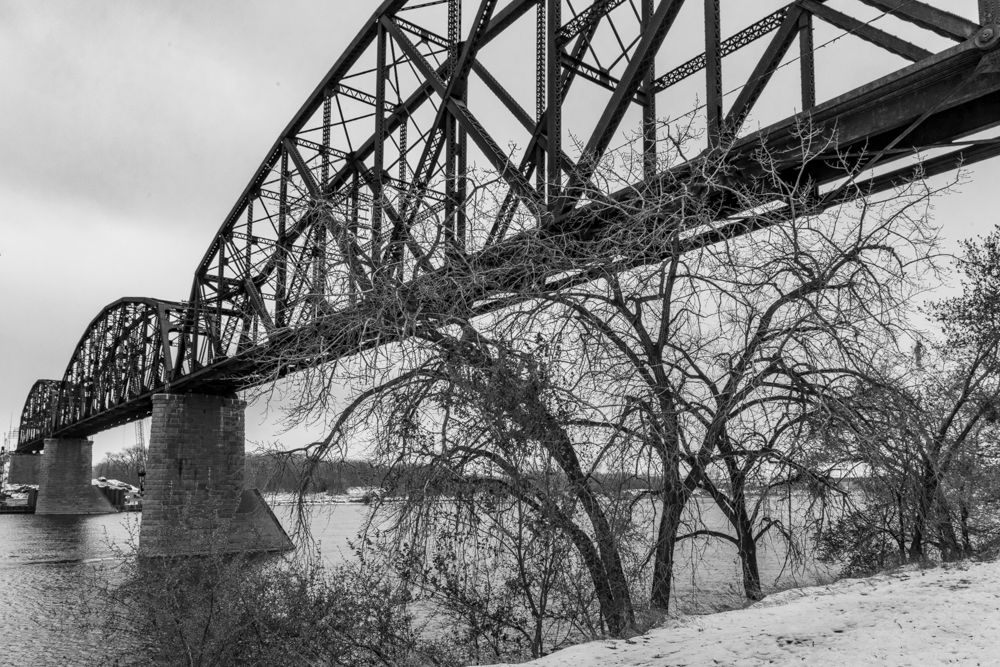
As my last stop, I drove down the the Missouri River to see the rail bridge that connects Bismark and Manden. This bridge was originally built by the Northern Pacific Railway Company during 1880–1883, predating North Dakota statehood by six years. The original truss spans constructed in 1883 were replaced in 1905 and the granite pier structures are the only original bridge elements that remain. Because the vertical and horizontal clearances limit the size and type of rail cars that can use it, a project is underway to completely replace and modernize the bridge. I had seen old images of this bridge yesterday at Magic Photo, and wanted to take some of my own. I was limited to the foot trail along the bluff, as the banks down the river’s edge were covered in snow, likely covering ice. So I had to make do with shooting around the denuded trees.
I then retreated to the warmth of my room.
Tomorrow I drive further west to Medora, which is the jumping off point for Roosevelt National Park.
When I arrived at the museum, I was warmly greeted by Leo and Harlo at the front desk. We spent some time chatting about both my trip and the museum before I went off to peruse the exhibits. This is a very well done museum; the exhibits are clean and the text on the boards is actually legible without requiring a close-up encounter with a magnifying glass.
I started in the screening room, where a plethora of vignettes featuring Native American story tellers were available on demand. Harlo had also handed me a note with a QR code to access the hours of stories directly from the internet on my own time. These vignettes lead into an exhibit entitled On the Edge of the Wind; Native Storytellers & the Land . This was a beautifully curated exhibit, down to the background of authentic flute music. The light was subtly dimmed, adding to the atmosphere of sanctity and calm. Each story featured a different cultural element or land feature, highlighted by large images related to the story. Several stations featured on-demand stories, again relating to the specific topics. A second room housing the Innovation Gallery is also devoted to a history of the early peoples of North Dakota. It provides a more typical narrative that nicely complements the storytelling approach
A third room, the Adaptation Gallery , explores the history of North Dakota from the perspective of geology and paleontology. Like the other Plains States, the western half of North Dakota was once a primordial ocean that morphed through several different ecosystems before becoming the high plains and badlands of current existence. As such, the area is rich in fossils that help tell the ecological history of the area.
The fourth and last room, housing the Inspiration Gallery , tells the story of the State of North Dakota using themed exhibits. I was interested to learn that the majority of the early European-American settlers were of Nordic or German ancestry, with a smattering of Eastern Europeans. And of course that is reflected in the customer and culture of the region. Modern museums appear to have completely given up on timelines. While I appreciate the themed approach, my linear mind would also like a timeline in which to put everything in context. History.com gives a nice summary, and additional information can be found on the Wiki page .
The land that today makes up North Dakota first became a U.S. territory as part of the Louisiana Purchase of 1803. The region was originally part of the Minnesota and Nebraska territories, until, along with what is now South Dakota, it was organized into the Dakota Territory in 1861 . Although settlers began to arrive in earnest in response to the Homestead Act of 1862, the territory remained sparsely populated until the arrival of the railroads in the late 1800s. Relations between the two territories were not entirely congenial. Once the Dakota Territory was split into North Dakota and South Dakota, an intense rivalry developed over which state would be admitted to the union first. When the time came for their formal admission, President Benjamin Harrison selected at random which bill to sign first and did not record the order in which the bills were signed. Both states entered the Union in 1889 . Ironically, Dakota is a Sioux Indian word that translates to "friend."
After spending a couple of hours with the exhibits, and grabbing a cup of coffee at the cafe, I returned to the front desk with a couple of questions. As I was asking them, Tom, who works at the museum (I think as a curator) happened to walk up and helped to answer my questions. I wondered why, in spite of the excellent Native American exhibits, there was no land acknowledgment statement, as I have seen in other museums. Tom said that was something currently under discussion, and they were working closely with local Tribal members to address the issue. I also wondered about any African-American history in the region. Not unexpectedly, the population, both historically and present day, was and is quite small. And because of the physical distance from the events the precipitated the Civil War and subsequent Civil Rights events, the Dakotas really were on the periphery of those issues. We continued our discussion to include a wide range of topics, including politics, the environment, national events and world events. This was a very informative morning, and I enjoyed learning from all three gentlemen. It was also warm and dry which provided a nice break.
After leaving the Heritage Center, I drove around the corner to take a look at the North Dakota State Capitol building . This is the first Capitol I have seen that does not feature a Neo-classical dome. It is completely modern, square and utilitarian. The original Greek Revival building was destroyed by fire in 1930 and it was decided to rebuild on the same site in a modern style.
As my last stop, I drove down the the Missouri River to see the rail bridge that connects Bismark and Manden. This bridge was originally built by the Northern Pacific Railway Company during 1880–1883, predating North Dakota statehood by six years. The original truss spans constructed in 1883 were replaced in 1905 and the granite pier structures are the only original bridge elements that remain. Because the vertical and horizontal clearances limit the size and type of rail cars that can use it, a project is underway to completely replace and modernize the bridge. I had seen old images of this bridge yesterday at Magic Photo, and wanted to take some of my own. I was limited to the foot trail along the bluff, as the banks down the river’s edge were covered in snow, likely covering ice. So I had to make do with shooting around the denuded trees.
I then retreated to the warmth of my room.
Tomorrow I drive further west to Medora, which is the jumping off point for Roosevelt National Park.
61 photo galleries
50 States
- Big Sur
- Salinas
- Laguna Beach
- San Diego
- California
- Grand Canyon
- Sedona
- Utah
- Syracuse
- Moab
- Denver
- Manitou Springs
- Calhan
- Mesa Verde
- Los Alamos
- Santa Fe
- Carlsbad
- New Mexico
- Eureka Springs
- Little Rock
- Birmingham
- Jackson
- Lottie
- Ten Thousand Islands
- Jerome
- Savannah
- White
- Asheville
- Sandstone Falls
- Baltimore
- Timonium
- Maryland
- Berlin
- Milton
- Smyrna
- Ocean City
- Detroit
- Upper Peninsula of Michigan
- Michigan
- Herod
- Ozark
- Two Harbors
- Carlton
- Madison County
- Oakley
- Valentine
- South Dakota
- United States
- Yellowstone National Park
- Lima
- Idaho
- Port Townsend
- Lincoln City
- Newport
- San Francisco